The general manager's weekly property walk: a route, a score sheet and a follow-up list
A property walk needs a fixed route, a simple score sheet, and a list that closes. This guide gives you the six-stop route, the scoring rules, and the follow-up method to turn observations into action.
AI draft · awaiting editorial review
Contents
Key takeaways
- A property walk produces three things: what you saw, a score against a written standard, and a list with an owner and a date. A walk with no list is a stroll.
- The route is fixed on purpose: same stops, same order, same hour, so week 12 can be read against week 11 and slow drift becomes visible.
- Score the building, not the person: one to three per line, one written sentence per score, and no total to chase.
- Every finding becomes one line with an owner, a department and a date, sent the same day, and the next walk starts by standing at that spot and looking.
- A finding that appears three weeks running is a process problem, not a housekeeping problem, and the process is what changes.
A general manager's property walk is a fixed 30 to 45 minute route through the same guest-facing and back-of-house areas each week, scored on a one-page sheet from one to three, and closed with a dated action list that goes to the responsible department head the same day. The route stays constant so weeks can be compared.
Most managers walk their hotel every day and see almost nothing, because the walk follows the pleasant path: lobby, desk, a short word with the front office team, back to the office. The places that fail quietly, the service corridor, the pool plant room, the third-floor landing at eleven at night, are the ones nobody visits on purpose. After reading this article you will have a complete general manager property walk checklist: a six-stop route with time budgets, a one-page score sheet, and a follow-up list that closes.
What is a general manager's property walk?
It is the manager's own weekly habit: a fixed route through the building, walked in 30 to 45 minutes, scored on one page, and closed with a dated list of actions. It looks at the building and the process, not at individual performance and not at records. If you want the wider frame of the role, read what a hotel general manager does and what authority the role carries.
Three outputs, every time: what you saw, a score against a standard you have written down, and a list with an owner and a date. Drop any one and the walk stops changing anything.
It is not a room inspection. A supervisor checks every room before release against a room standard, as described in how a supervisor inspects a room before release; the walk passes one room, not forty. It is not a mystery guest audit either, which tests the guest experience end to end from the outside and is planned as a project. And it is not an internal audit, which samples records, controls and money and belongs to a different calendar.
The general manager walks rather than a deputy because only that role can commit budget and move two departments against each other on the spot. Authority is the whole point of the habit.
Time-box it: same day of the week, same hour where the operation allows, 30 to 45 minutes. An open-ended walk gets postponed. Write while walking, one note per stop. A walk reconstructed from memory at the desk records the last thing you saw, not the worst.
Why does a fixed route beat a random walk?
A random walk drifts toward the areas that are pleasant and the people who are comfortable, so the same two corridors get walked and the same three problems get missed. A fixed route removes the choice of where to go.
Comparability is the first reason: same stops, same order, same standard, so this week can be read line by line against last week. A random walk produces impressions, and impressions cannot be compared.
Most hotel failures are slow. A scuff becomes a hole, a smell becomes normal, a printed sign stopped being true two seasons ago. Only a repeated look at the same spot catches slow drift. Coverage is the second reason: the route forces the back of house, the loading bay, the plant room and the night view into the week, which is where the guest never goes and where much of the guest's experience is decided.
Predictability for staff matters too. A known route on a known day turns the walk into a routine people prepare for, not a raid they hide from. Unannounced is not the same as unpredictable.
Keep one variable stop: the core stays fixed, and each week adds one rotating stop, a floor, an outlet, a store, so the rest of the building is not blind. Order matters as well. Once a month walk the guest journey in the guest's order, arrival to room; on the other weeks reverse it, because the reverse direction shows what the guest sees last and remembers. For the contrast with an outside review, see how a mystery guest audit differs from the manager's own walk.
Where should the route go, stop by stop?
Six stops cover a hotel: arrival, lobby and desk, one guest floor with one room, food and beverage with the kitchen pass, back of house, and the outdoors. A seventh, the night view, runs once a week after dark.
Walk the stops in the same order every week and give each one a time budget, so the walk ends when it should rather than when you run out of interest. At every stop, look at three things: the state of the surface (clean, intact, lit), the state of the information (signs, menus, printed notices still true), and the state of the flow (where people queue, wait or squeeze past). Carry the same three questions to every stop and write the answers down; the answers become a series as useful as the scores.
The night view is a separate walk, not an extension of the day one: lighting, noise, night staffing, security rounds and the path from the car park to the door look different at 23:00. If the hotel has more than one building or outlet, rotate the seventh slot rather than lengthening the route. A 90-minute walk does not happen weekly.
| Stop | Minutes | What you look at | What you ask |
|---|---|---|---|
| Arrival and forecourt | 5 | Signage legible from the road, drop-off congestion, glass, ashtrays, lighting at dusk, luggage trolley available | Where do guests wait when it rains? |
| Lobby and front desk | 7 | Queue at this hour, the first 30 seconds of a check-in you overhear, seating, smell, music level, printed material still true, lift lobby | What did you have to apologize for this week? |
| One guest floor and one room | 8 | Corridor lighting, vacuum lines, trolley blocking a door, the room being cleaned or just released (bed, bathroom, minibar, air, the view from the window) | Which room gives you the most trouble? |
| Food and beverage, kitchen pass | 7 | Buffet holding records, the pass during service, table reset speed, menu printing, the corridor into the kitchen | What runs out first? |
| Back of house | 6 | Housekeeping store, laundry and linen counts, engineering workshop, staff changing and canteen, waste separation, loading bay | What is on the list nobody has approved? |
| Outdoors | 6 | Pool deck and water clarity, sunbeds, garden edges, car park, perimeter, drains | What breaks after rain? |
| Night view, once a week | 10 | Lighting, noise, night desk staffing, security rounds, bar closing, the walk from car park to door |
What belongs on a one-to-three score sheet?
One page, one line per stop, plus a few cross-cutting lines, each scored one to three: one means below standard and needs an action, two means acceptable but drifting, three means the standard is held.
Score the building, not the person. The sheet records the state of the place; anything about an individual goes into a separate conversation with the department head. Anchor every score with one written sentence: what you saw, where exactly, at what time. A three with no note is worthless in week six, when you cannot remember why you gave it.
Do not total the sheet. An average invites chasing the number; the signal is a line that stays at one, or a line that falls from three to two twice in a month. Read the sheet against last week line by line, never in total. Two lines moving in opposite directions is information; a stable average is not. Keep the lines identical for at least a quarter, because changing the sheet resets the series and you lose the only thing it was for. Ten to twelve lines is the ceiling: a sheet that takes longer to fill than to walk will be filled from the desk.
| Sheet line | 1, action needed | 2, drifting | 3, held |
|---|---|---|---|
| Arrival and forecourt | Litter, dead sign, dark entrance | One item out of place | Clean, lit, signed, staffed |
| Lobby and desk | Queue with one clerk, stale print | Queue at peak only | Queue managed, print current |
| Guest floor and room | Defect a guest would report | Wear visible but sound | As the room standard says |
| F&B and kitchen pass | Holding records missing, pass backed up | Records kept, pass slow at peak | Records current, pass clear |
| Back of house | Blocked exit, overflowing store | Untidy but safe | Ordered and labelled |
| Outdoors | Safety or hygiene issue | Maintenance pending | Clean and complete |
Add cross-cutting lines for cleanliness, lighting, signage and print, smell and sound, and safety (trip, cable, wet floor, blocked exit).
How do you talk to staff on the walk without turning it into an inspection?
Ask about the work, not about blame. The person doing the task knows where the process breaks, and has usually stopped expecting anyone to ask.
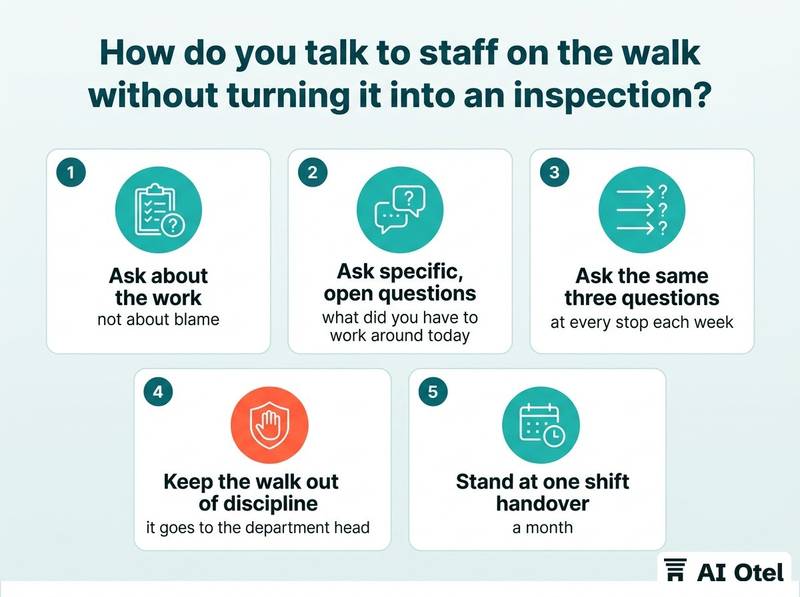
Ask specific, open questions: what did you have to work around today, what would you fix with a small budget, what runs out first. Vague questions get reassuring answers. Never correct a person in front of a guest or in front of their colleagues; note it, and speak to them or their head afterwards.
Ask the same three questions at every stop each week. The answers become a series: the same complaint from three different people is a system fault, not three opinions. Write the name and the answer, and come back next week to say what happened. An unanswered question teaches staff that answering is pointless, and the walk goes quiet.
Keep the walk out of discipline. If a conduct issue appears, it goes to the department head as a separate matter, or people start managing the walk instead of the work. Stand at one shift handover a month: most of what the walk finds, the outgoing shift already knew and the incoming shift never heard.
TipThree questions to carry to every stop
What did you have to work around today? What would you fix with a small budget? What runs out first? Note the answer and the name, and report back next week.
How do you turn findings into a follow-up list that closes?
Every finding becomes one line with an owner, a department and a date, and the list goes to the department heads the same day. The list stays short on purpose: five open items that close beat twenty that age.
Sort each finding into one of three buckets: fix today (safety, or anything a guest can see), fix this week (owner is the department head), and capital (needs money or a supplier, so it goes to the owner with a photograph and a cost range). One list, not five: the same list carries from week to week and nothing is retyped, because a second list is where items go to be forgotten.
Close on site, not on paper. The next walk begins by standing at the first open item and looking at it, because a report saying it is done is not the same as a fitting that is fixed. Before leaving the office, read last week's list and choose the two items you will verify first. That single minute is what separates a list from a diary.
A finding that appears three weeks running is a process problem, not a housekeeping problem. Change the process, the schedule or the supplier, not the wording of the reminder. A shared sheet is enough to run this. If the hotel uses a hotel operating system (the system: built, ahead of launch) that keeps room status and maintenance records, the finding belongs next to the room so the next person to open that room sees it. The internal audit samples this list later, as described in how a quarterly internal audit samples the manager's follow-up list, which is why each line has to record the date it was closed and by whom. If you are weighing what such a system should cover overall, the hotel technology platform overview (the platform: built, ahead of launch) is a place to start.
ChecklistThe follow-up line
- what exactly is wrong
- where exactly (building, floor, room or asset number)
- when it was seen and by whom
- which bucket (today, this week, capital)
- owner by name, not by department
- due date
- photograph attached
- closed on date and by whom
What to do next
The route, the sheet and the list only work as a series, so the next step is small and dated: put the same hour in next week's calendar, walk the same six stops, and start by standing at the first open item from this week's list. Do that four weeks running and you have something a random walk can never give you, a line of comparison and a list that closes.
Frequently asked questions
How long should a general manager's property walk take?
Thirty to 45 minutes for the six daytime stops, with a separate short night walk once a week. The time budget per stop is what keeps it weekly; a longer walk gets postponed, and a walk that happens is worth more than a thorough one that does not.
Should the general manager walk alone or with the department head?
Mostly alone, because staff speak differently when their manager is standing there and the walk stays about the building. Take a department head when the stop is technical and you need a decision on the spot, and say in advance that the walk is not a performance review.
Does a property walk replace room inspections or mystery guest audits?
No. The walk passes one room and looks at the building and the process; a room inspection checks every released room against a room standard, and a mystery guest audit tests the whole guest experience from outside. They answer different questions and belong on different calendars.
How often should the route change?
Keep the core stops and the sheet lines identical for at least a quarter, then review once. Add or drop one rotating stop rather than redesigning the route, because a changed route breaks the week-to-week comparison that gives the walk its value.
What should a general manager never do on a property walk?
Never correct a staff member in front of a guest, never use the walk as a disciplinary tool, and never let a finding stay on the list without an owner and a date. Each of these teaches people to manage the walk instead of the work.