When a staff member leaves: the exit interview, the handback list and same-day access removal
A structured exit interview and a signed handback list protect your hotel. Learn how to close system access on the last day and read seasonal patterns to improve retention.
AI draft · awaiting editorial review
Contents
Key takeaways
- The hotel staff exit interview works better when the direct manager is not in the room: people describe the shift, the tools and the guests, not the person who wrote the roster.
- A handback list signed by the leaver and a witness turns keys, radios, uniforms, lockers and badges from a memory test into a record.
- Access removal is a same-day task: a mailbox left open keeps receiving guest messages after the person has gone.
- Every open guest request and unfinished task needs a named new owner before the last day, not after it.
- Exit notes are worth more read together at the end of a season than one at a time.
The exit interview is a short, structured conversation held on or before the last working day by someone other than the direct manager. The leaving day then runs on three tracks: the conversation, a signed handback of keys, radio, uniform, locker and badge, and same-day removal of system, mailbox and messaging access.
The last shift ends at 23:00. The locker key comes back, the radio does not, the uniform is promised for tomorrow, and the front-desk account still opens on Monday morning. Most of that is fixable with one page used the same way every time. After reading this you will know who holds the conversation, what to ask, what to collect back, how to close access on the day, and how to read the notes across a season.
Who should hold the exit interview, and why not the direct manager?
Someone one step away from the daily roster: the general manager in a small hotel, HR or another department head in a larger one. The direct manager supplies the facts, not the room.
The direct manager is often part of the reason the person is leaving, and answers get shorter and politer when they are present. The interviewer also needs the authority to act on what is heard, such as a key card encoder that fails twice a shift or a roster published too late to plan around. Without that authority, the conversation becomes a complaint box.
The direct manager still writes the factual part before the meeting: start and end dates, tasks in hand, equipment issued, and any performance note that belongs in the file. In a small hotel where the manager is the only person who can hold the interview, hold it anyway. Ask the same written questions and record the answers in the person's own words so the pattern is still visible.
Book 30 minutes in a closed office away from the desk, not the lobby and not the last hour of a shift. Open by saying what happens to the notes: who reads them, how long they are kept, and that this conversation is not a reference. Keep the conversation about how the work went. Final pay, documents and any dispute belong in a separate meeting with whoever runs payroll.
What are the five exit interview questions worth asking in a hotel?
Ask about the shift, the tools, the handover, the first month and what would bring them back. Five questions asked the same way every time produce notes you can compare across a season.
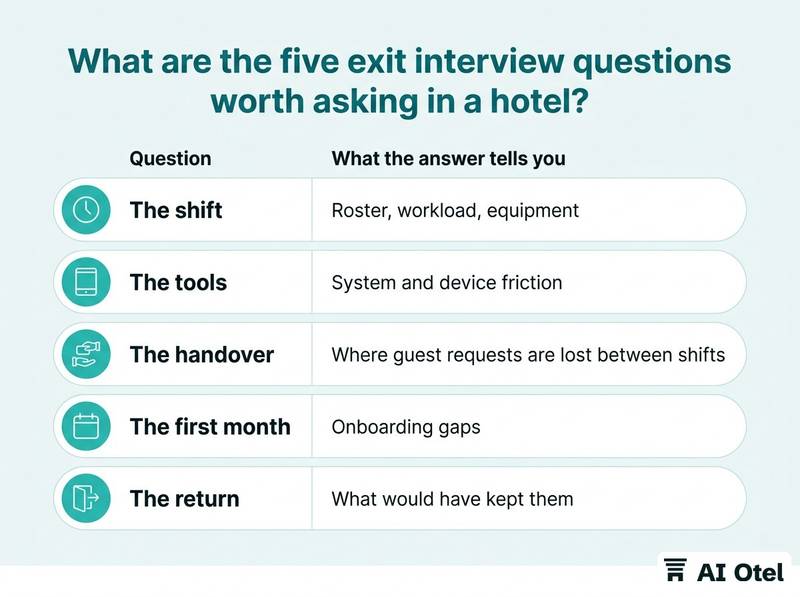
Question one, the shift: walk me through a normal shift, what takes the longest and what gets in the way. This surfaces rosters, staffing gaps and equipment before opinions. Question two, the tools: which system or device made your work harder than it needed to be. Expect answers about the property management system, the key card encoder, radio coverage or a printer nobody fixes.
Question three, the handover: when you passed a guest request to the next shift, what got lost. The answer tells you whether the shift handover book, a messaging group or a verbal word is doing the work. Question four, the first month: what did you need when you started that you did not get. Training, shadowing, language support and uniform sizes appear here, and they are cheap to fix. Question five, the return: what would have made you stay, or what would bring you back. Pay is usually the first answer, so ask for the second and third.
Record one line per question in the person's own words, plus department, month of joining and whether the departure was the person's decision. No scores: a rating from one to five hides the sentence you can act on. Do not argue with an answer and do not promise a change in the room. Write it down and say who will read it.
| Question | What the answer tells you | Where it goes |
|---|---|---|
| The shift | Roster, workload, equipment | Department file |
| The tools | System and device friction | Maintenance ticket |
| The handover | Where guest requests are lost between shifts | Department file |
| The first month | Onboarding gaps | Training plan |
| The return | What would have kept them | Seasonal summary sheet |
The handback list: what should a hotel get back on the last day?
Everything the hotel issued: keys and key cards, radio and charger, uniform and name badge, locker key, staff card, tools and any device. Each line is signed and dated by the leaver and a witness.
Build the list from the issue record, not from memory: whatever was signed out is signed back in, on the same sheet if the hotel keeps one. This is the receiving end of staff equipment custody: signing items out and getting them back. Keys cover more than the front door: physical keys, master keys, key cards, safe keys, vehicle keys, storage and office keys. A master key that does not come back is a lock change decision, not a note in the file.
Uniform pieces are counted and their condition noted. Anything about cost belongs in the hotel's own written policy agreed when the item was issued, not in a conversation on the last morning. The locker is emptied in front of a witness, the locker key returned and the locker reassigned. The name badge is returned, or logged as lost and destroyed in the record, since a badge with a person's name and the hotel's logo outlives the employment; see what to do with a returned or lost staff name badge.
Two signatures and a date, one copy to the person and one to the file, with a line for items not returned and what happens next.
ChecklistHandback checklist (returned yes or no, condition, leaver and witness signatures)
- Master keys and physical keys
- Key cards
- Safe keys
- Vehicle keys
- Radio, charger and earpiece
- Uniform pieces
- Name badge
- Locker key and locker emptied
- Staff or meal card
- Parking permit
- Company phone or tablet
- Headset
- Trade tools
- Any other item on the issue record
How do you close system, mailbox and messaging access the same day?
Work from a written list of every account the role touches, close each one by name on the last working day, and record who closed it. The account is the risk, not the person.
Start from the role, not the person: the property management system login, the mailbox and shared inbox, the booking channels, the travel agency extranets, the channel manager, the payment terminal user, the door-lock or key-card system, the Wi-Fi administration, the camera viewer, the guest messaging device, the staff messaging groups and the shared drive. Order the work on the last day: money and guest data first, meaning payment, property management system and agency extranets, then the mailbox, then the messaging groups.
For the mailbox, set an auto-reply naming a colleague for a defined period, forward or delegate to the new owner, then disable the account. Leaving it open to catch anything is how guest data reaches a former employee. Shared logins defeat the whole exercise: if the front desk works from one account for everyone, no single person's access can be closed, and named accounts per person are the fix. A PMS user roles and permissions setup checklist prevents this before anyone leaves; the same discipline matters in any hotel operating system (the system: built, ahead of launch).
For messaging, remove the person from the staff group and from the device list of any guest-facing number, and change the password on every shared account the person could open. Record the closure: who closed it, at what time, and how the hotel knows. A closure nobody wrote down is a closure nobody can prove. Ask for hotel photos of guest documents and personal notes to be removed from any phone the person used, and wipe a hotel-issued device before it is reissued.
| Access | Who closes it | When on the last day | Proof kept |
|---|---|---|---|
| PMS login | Duty manager | Morning | Dated line in file |
| Agency and channel extranets | Reservations lead | Morning | Screenshot |
| Payment terminal user | Duty manager | Morning | Terminal log |
| Hotel mailbox and shared inbox | IT or office manager | Midday | Auto-reply copy |
| Guest messaging device | Duty manager | Midday | Device list printout |
| Staff messaging group | Department head | Afternoon | Screenshot |
| Shared drive | Office manager | Afternoon | Access list |
| Door-lock or key-card system | Duty manager | Afternoon | System log |
| Camera viewer | Duty manager | Afternoon | Dated line in file |
| Wi-Fi administration | Office manager | Afternoon | Password change note |
How do you hand over open tasks and guest requests before the last day?
Two days before the last day, everything in the person's hands gets a named new owner and a date. Nothing should still sit with someone who is leaving.
Walk the open list together: group blocks, pending confirmations, unassigned arrivals, VIP setups, complaints in progress, supplier orders, maintenance tickets and lost-and-found items waiting to be posted. Anything promised to a guest in writing, such as a late checkout, an airport transfer or a cot, goes into the handover note with the guest's name, room and the exact promise.
The handover note is one page, written by the leaving person and checked by the department head, kept where the next shift actually looks: the shift handover book or the notes on the reservation, never a personal folder. Reassign inside the system as well as on paper: the reservation owner, the task assignee and the ticket owner all change hands.
Tell the guests who are mid-conversation. A short message naming the new contact before the last day prevents a guest writing to a mailbox that no longer answers. Introduce the new contact to regular suppliers and agencies in one email, copied to the department head. Check the list on the morning of the last day, not at 18:00 when the person is already handing in the radio.
TipIf a task cannot be given to a named person two days before the last day, that is a staffing problem, not a handover problem. The fix is a deputy named in advance, not a longer handover note.
If a task cannot be given to a named person two days before the last day, that is a staffing problem, not a handover problem. The fix is a deputy named in advance, not a longer handover note.
How do you read exit notes across a season for patterns?
Read them together, once a season, sorted by department and by month. One note is an opinion; a dozen notes naming the same broken thing are a repair with a price.
Keep one summary sheet: date, department, month of joining, whether the departure was the person's decision, and the five answers in short form, with no names. Count repeats rather than scores: how many notes mention the roster, the key card encoder, the handover between shifts or the first month. Compare by department and by season. The same complaint in July and in December is a system; the same complaint in one week of August may be one bad week.
Close the loop: pick one item each season, fix it, and say in the next hiring round what changed. Notes that change nothing stop being honest. Treat a run of notes that all say everything was fine as a signal about the interviewer, not about the hotel. Feed the findings into staff turnover: calculating the rate and finding where people leave, so the pattern has a denominator and a month attached to it.
Decide who may read the notes and for how long, and say it at the start of every interview. The notes describe people, so the hotel's own retention rule applies to them.
Key pointThe summary sheet holds no names. Names stay in the individual file; the season is read from the anonymous sheet, which is the only version that should be shared with department heads.
The summary sheet holds no names. Names stay in the individual file; the season is read from the anonymous sheet, which is the only version that should be shared with department heads.
What to do next
Put the leaving day on one page and use it every time: the five questions asked by someone other than the direct manager, the handback list signed by two people, the access table closed and recorded the same day, and the handover checked two days early. Then read the notes once a season, fix one thing, and say so at the next hire. Your next step this week: write the account list for one role, the front desk, and check that every login in it belongs to a named person. The wider setup of roles and permissions across a hotel is covered on the platform overview (the system: built, ahead of launch).
Frequently asked questions
Can the hotel staff exit interview be held by phone or video if someone leaves suddenly?
Yes, and a written form returned by email is better than nothing. Record who asked, when, the five questions and the answers in the person's own words. The handback list still needs a real return, so agree a date for keys, radio and uniform and put it in writing.
What do we do if the person does not return the uniform or the radio?
Mark the item as not returned on the signed list, with the date and the condition. Apply whatever the hotel wrote down when the item was issued, and pass any question about charging the person to payroll or the hotel's adviser. The operational decision, replacing the radio or re-keying a lock, should not wait for that answer.
Should we keep the former employee's mailbox open for a while?
Keep the address working, not the person's access. Set an auto-reply naming a colleague, delegate or forward the mail to that colleague for a defined period, then disable the account. An account still open with the leaver's own password is the risk the whole process is meant to remove.
Do we need one form or two?
Two, one page each. The interview note records what was said and is read by management at the end of a season. The handback list records what came back, signed by the leaver and a witness, and is read when an item is missing. Mixing them means neither gets read.
How long should exit interview notes be kept?
The hotel sets the period in its own written rule, says it at the start of the interview and applies it to every leaver. The notes describe people, so keep the summary rather than a recording, restrict who may read them, and confirm the retention period with the hotel's adviser.