A guest shuttle to the beach or town: timetable, stops, capacity and a sign guests understand
Decide if a shuttle is worth running by checking demand patterns and costs. Size the service from a two-week rider log and publish one clear booking rule to prevent disputes.
AI draft · awaiting editorial review
Contents
Key takeaways
- A shuttle is worth running only when the same trip is requested at a predictable time; otherwise a taxi arrangement serves guests better than an owned vehicle.
- The return leg decides whether guests trust the service: publish the last return time and the exact meeting point before anything else.
- Size the vehicle and the frequency from a two-week rider log per departure, not from the room count or the daily average.
- One booking and payment rule, printed where the guest decides and applied the same way by the desk and the driver, prevents most arguments at the stop.
- A five-column daily log of riders and delays is what turns shuttle complaints into timetable decisions.
A hotel shuttle beach town timetable is a scheduled vehicle between the hotel and fixed stops such as a beach or town center. Run it only where the same trip is requested at a predictable time, choose stops guests can name, size departures from a two-week rider log, print one booking and payment rule, and log riders and delays daily.
The 09:00 shuttle left at 08:55 with four seats empty, and the family that reached the lobby at 08:58 is now standing at the desk. Almost every shuttle complaint is a rule that was never written down, not a vehicle that broke. After reading this guide you will be able to decide whether a shuttle is worth running, choose stops and times from what guests actually do, size the service from a rider log, write one payment and booking rule, and put a sign at the stop that answers questions before they reach your desk.
Is a guest shuttle worth running at all?
Run a shuttle only when the same trip is requested at a predictable time and the alternatives leave guests stranded; otherwise arrange transport without owning a vehicle.
Start with a list of the trips guests actually ask for: beach club, town center, marina, shopping mall, old town. A destination that appears once a week is a taxi job, not a route. The pattern matters more than the volume, because a shuttle is a commitment to a time, and a time only holds when demand repeats.
Compare three ways of covering the trip. The hotel can run its own vehicle and driver. It can contract a partner van on a fixed schedule. Or the desk can simply call a taxi and let the guest arrange payment. Each has a cost profile and a service profile, and the cheapest is not always the one guests prefer. The airport run is a different job with its own rules, covered in the airport transfer guide.
Work out a cost per trip before committing. Add driver hours taken from another job, fuel, a share of the vehicle's fixed costs, insurance, and any parking or entry fee at the far end, then divide by the trips the hotel will actually run. For example, a vehicle that costs 1,000 a day all in and runs 10 trips costs 100 a trip before a single guest boards. That number, next to the taxi fare for the same trip, tells you whether the shuttle is a service or a subsidy.
Count what the shuttle replaces: front-desk time spent calling taxis, guests who come back late and angry, and disputes over who pays when the hotel promised transport. These are real costs, but they are not unlimited, and they belong in the same calculation as fuel.
Test before committing. Run the route for two weeks on a fixed timetable with a rider log, then decide from the log rather than from opinion. Name one owner, whether guest relations, the front office or a transport coordinator. A shuttle with two owners has two timetables.
Key pointFour questions before a vehicle is assigned
(1) Is the same trip requested at roughly the same time most days? (2) Is there no reliable alternative at that hour? (3) Can one driver cover it without leaving another job uncovered? (4) Can the hotel keep the timetable on its busiest day? Four yes answers: run it. Fewer: arrange transport without owning it.
Which stops and times should the shuttle run?
Choose stops a guest can name and a driver can legally stop at, and set times from what guests already do in the day rather than from a round number.
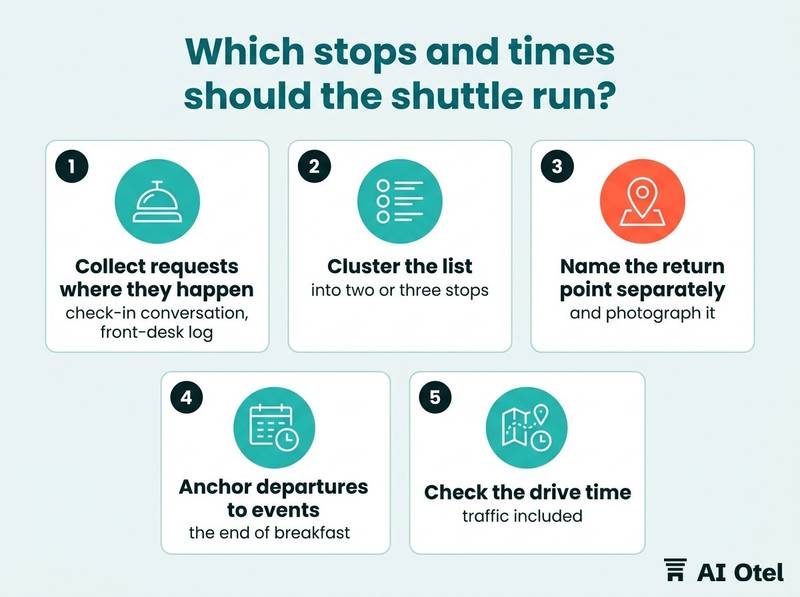
Collect requests where they happen: the check-in conversation, the front-desk log, messages to the guest relations line, and the questions guests ask on the day. Two weeks of this produces a real destination list. It will be shorter than the one in your head, and it will be more honest.
Cluster the list into two or three stops. Five stops on one loop means nobody arrives anywhere on time, and a second loop at a different hour usually beats a longer route. A stop must pass three tests: a guest can describe it so that a driver understands the same spot, a vehicle can stand there without blocking traffic, and there is shade, a seat or a light. The skill of naming a place so that a guest and a driver understand the same spot is worth practicing here, because it is the same skill the sign will need.
Name the return point separately and photograph it. The outbound stop is where guests are dropped; the return point is where they must find the vehicle at a named hour, and it is often a different corner. A photograph on the room information sheet settles the question before it is asked.
Anchor departures to events guests already know: the end of breakfast, the hour the beach club opens, the start of dinner service. A 09:17 departure is precise and useless. Publish the last return before anything else. Guests forgive a late outbound vehicle; they do not forgive being stranded at 19:00 with no way back.
Check the drive time at the hour the vehicle will actually drive it, traffic included, then add loading time at the stop. A timetable built on an empty-road estimate fails on the first busy afternoon.
How many seats and how many departures do you need?
Size the vehicle and the frequency from the busiest departure in a two-week rider log, not from the room count or the average.
Record riders per departure, not riders per day. The daily total hides the fact that one departure is full and three are empty. Keep a walk-up margin: a departure that is full on the log will be over-full on the day a group decides to travel together. Publish the seat limit so the driver applies a rule instead of making a judgment call at the door.
Trade vehicle size against frequency. One large vehicle at low demand costs a driver and fuel for empty seats; one small van at peak turns into a queue at the stop. Two departures of a small van often beat one departure of a large one. Plan for what guests carry: beach bags, buggies, wheelchairs, shopping. A seat count that ignores a folded wheelchair is wrong on the day it matters.
Departure day changes the pattern: guests with late flights fill the midday departures and need luggage space, which is the subject of the departure-day guide. Change one thing at a time and give it a week. A timetable that changes daily teaches guests to stop reading it.
| What the rider log shows | What to change |
|---|---|
| First departure full every day, later ones half empty | Move the first departure earlier or add a second vehicle at that hour; leave the later times alone. |
| Mid-morning and early-afternoon departures empty | Cut one, keep one, and put the driver hours into the last return. |
| Last return crowded, guests standing | Add a second run later or move the last return, and announce it on the sign at the stop. |
| Riders spread evenly, no departure full | Reduce frequency and keep the vehicle size; reliability is worth more than choice. |
| Same delay every afternoon | Move the departure out of the traffic peak instead of asking the driver to make up time. |
Should the shuttle be free, paid, or booked in advance?
Any of the three can work; what fails is a rule that differs between the booking confirmation, the desk and the driver. Choose one rule, print it where the guest decides, and apply it identically.
There are four workable rules: free for all in-house guests, free but booked, paid per seat charged to the room bill, or run by a partner who charges the guest directly. Pick one and write it down. Cash in the vehicle is the option to avoid: the driver handles money, the till and the log disagree, and the argument happens at the stop with a queue watching.
If a seat is paid, the price must be visible before the guest boards: on the sign, in the booking confirmation and at the desk. A price discovered at the door is a complaint with a receipt. Set a booking cut-off and a no-show rule, and publish both. For example: seats can be booked until one hour before departure, and a booked seat is released two minutes before the vehicle leaves.
Decide who may ride: in-house guests only, or also their visitors and staff. A rule that is not written becomes a negotiation at the door every evening. Print the rule in the same words at check-in, on the room information, on the stop sign and in the guest app if the hotel has one. Four places, one sentence. How a paid transfer is invoiced, and what the vehicle's insurance and the driver's authorization must cover, are questions for your accountant and your insurer.
ChecklistThe rule sheet, five lines to write before the first departure
- Who may ride: in-house guests, their visitors, staff, children of what age and at what price.
- What it costs: free, or the price per seat and how it is charged.
- How a seat is secured: walk-up until full, or booking with a cut-off time and a channel.
- How long the vehicle waits: the published number of minutes after the scheduled time.
- What happens when it is full: who is called, what the guest is offered, and who pays for the alternative.
What must the timetable and the sign actually say?
The sign at the stop must answer four questions at a glance: where the vehicle goes, when it leaves, whether the guest must book or pay, and what happens if it is full.
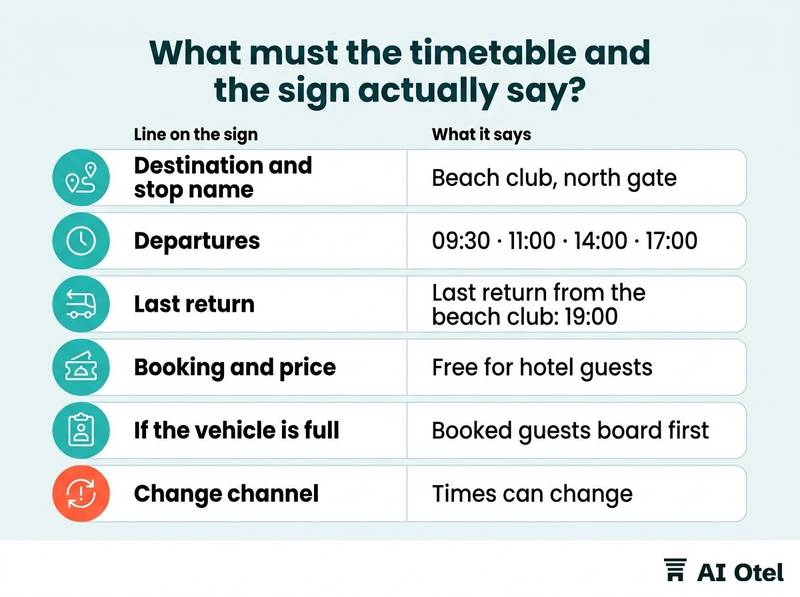
Put the last return in the largest type on the sign. It is the line guests photograph and the line they quote at the desk. Use the 24-hour clock and one time format everywhere. 6:00 pm on one sheet and 18:00 on another is how a guest misses the last vehicle.
Write the destination in the local language as well as the guest's, so a guest can show the name to a taxi driver if the shuttle is missed. Choose languages from the guests the hotel actually receives, not from a list of ten. Two or three done properly beat six done badly, and pictograms carry the rest.
Place the sign where the guest waits, not where the hotel would like it: at eye height at the stop, lit at night, and repeated at the desk and in the room information. Add one line for change: how a guest learns that a time has moved. A timetable without a change channel is a promise the hotel cannot keep. Never print a departure the hotel cannot hold on its busiest day. A timetable is a commitment, not an ambition.
| Line on the sign | What it says (illustrative wording) | Why it matters |
|---|---|---|
| Destination and stop name | Beach club, north gate | A guest can find it and a taxi driver can repeat it. |
| Departures | 09:30 · 11:00 · 14:00 · 17:00 | One format, 24-hour clock, no am or pm. |
| Last return | Last return from the beach club: 19:00 | The single line that prevents stranded guests. |
| Booking and price | Free for hotel guests · book at reception by 08:30 | The rule is read before the guest walks to the stop. |
| If the vehicle is full | Booked guests board first · reception will arrange the next departure | The driver applies a rule instead of making a decision. |
| Change channel | Times can change · ask reception or check the guest app | The hotel can move a time without breaking trust. |
Hotels that manage more of the guest's day from one system, including offers and requests before arrival, can read more about how a hotel platform handles guest communication.
What does the driver need to know, and what goes in the daily log?
A one-page driver brief and a five-column daily log turn shuttle complaints into timetable decisions.
The brief fits on one page: the route in order, the exact stopping point at each end, the waiting rule, who to call when the vehicle is full or late, what the driver may not promise, and how to help a guest with a wheelchair or a buggy. If the brief does not fit on one page, the route is too complicated or the rules are not decided yet.
The log has five columns: date, scheduled and actual departure, riders and free seats, delay and its reason, incident. Nothing else; a log with twenty columns is filled in for a week and then abandoned. The driver fills it in at the stop, not at the end of the shift. Reconstructed logs are guesswork.
Write down what happens when the vehicle breaks down: who is called, what the guests are told, and how they get back. That plan is worth more on the day than any apology. Hand the log to whoever writes next season's timetable. A season of logs is the only honest demand study a hotel can run for itself.
The same discipline applies to staff transport, where the rider rule sheet carries the shift times and the waiting rule.
TipThe ten-minute Monday review
Read the week's log with the front office, name the one departure to cut, the one to add and the one delay to fix, and change nothing else that week. Guests learn a timetable by repetition.
What to do next
Write the rule sheet first, then the timetable, then the sign. Start this week with one page covering who may ride, what it costs, how a seat is booked, how long the vehicle waits and what happens when it is full. Then run the route for two weeks with the log, and let the log, not the loudest complaint, decide the next change.
If you are reading this as a traveler rather than a hotel manager, you can browse hotels across Türkiye (opens in a new tab) and check each property's location before you book.
Frequently asked questions
Should a hotel shuttle be free for guests?
It can be free, free with a booking, or paid per seat, and none of these is wrong on its own. What decides whether it works is that the rule is chosen once, printed where the guest decides, and applied the same way at the desk, on the sign and by the driver. If a seat is paid, charge it to the room bill rather than taking cash in the vehicle.
How often should a hotel shuttle run?
Set frequency from the busiest departures in a two-week rider log, not from a round number or the room count. Fewer departures that always leave on time are trusted more than frequent ones that drift. Keep the last return fixed and adjust the middle of the day first.
What should the driver do when the shuttle is full?
Follow a published priority rule: booked guests board first, then walk-ups until the seat limit. The driver calls the desk, the desk offers the next departure or an alternative, and the event goes into the log with the number of guests left behind. Because the rule is on the sign, the driver is applying policy rather than refusing a guest.
How many languages should the shuttle timetable be in?
The ones the hotel actually receives guests in, usually two or three, plus pictograms for the times, the stop and the booking point. Write the destination in the local language too, so a guest can show it to a taxi driver. Keep one time format across every language.
Does the shuttle wait for guests who are late?
Publish a waiting time in minutes and keep it, because the guests who arrived on time are watching. The desk handles exceptions, not the driver at the stop. A booked seat released at a stated minute is easier to explain than a vehicle that waits for whoever is missing.