Checking an AI-written menu description: allergens, ingredients and claims the kitchen must confirm
An AI-written menu description is a draft, not a record. This guide explains how to verify ingredients, allergens and claims against recipe cards and supplier labels before printing.
AI draft · awaiting editorial review
Contents
Key takeaways
- An AI assistant writes from patterns in text, not from your kitchen, so it can add an ingredient the recipe does not use and leave out one it does.
- The recipe card is the only starting point: if a dish's ingredients and bought-in components are not written down, nobody can check the description.
- The allergen line is a statement of fact and belongs to the chef, written from the card and the supplier labels and signed, never generated.
- Words such as homemade, local, fresh or gluten-free are promises, and each one needs a document or a written kitchen practice behind it.
- Keep one approved version per dish with a date and a name, and recheck it when the recipe, a supplier or a language changes.
An AI-written menu description is a draft, not a record. Check it in three steps: rebuild the ingredient list from the recipe card, have the chef write and sign the allergen line, and confirm every wording claim such as homemade or local against a document. A named person approves before print. This is the AI menu description allergen check hotel kitchens can run on any dish.
For example: a dessert goes on the menu with a line an AI assistant wrote in seconds, "homemade pistachio tart, gluten-free", while the kitchen buys the pastry shell and the pistachio paste carries wheat starch. The text is fluent, the price is right, and nothing in it has been compared to the kitchen. After reading this, you will be able to take any AI-drafted menu line and turn it into text the kitchen can stand behind, with a record showing who checked it and when.
What does an AI assistant get wrong in menu text?
It gets the language right and the facts wrong. It writes fluent, appetizing sentences and fills any gap in what it was given with something plausible.
The assistant works from patterns in text, not from your kitchen. It does not know which stock you buy, whether the pastry is made on site, or what a supplier changed last month. The typical errors are small and confident: an ingredient added because it usually belongs to that dish, an ingredient dropped because the recipe card never listed it, a technique upgraded from oven-baked to grilled.
It also does not stop when it does not know. A person writing a menu pauses and asks the chef; a text generator keeps going and produces a complete sentence. An allergen can disappear for the same reason an ingredient appears: with no list to work from, the text describes what the dish usually contains.
A wrong menu line looks exactly like a right one. Fluency is not evidence, which is why reading the text again cannot be the check. The check has to compare the text to a source outside the text: the recipe card, the supplier label, the chef.
Watch outTreat every line as unverified
Treat every ingredient, technique and claim in an AI-written menu line as unverified until a person has compared it to the recipe card. The sentence reads well either way.
Why start the check from the recipe card?
Because the recipe card is the only document that says what the kitchen actually puts in the dish, and a description can only be checked against something written down. This is the foundation of the AI menu description allergen check hotel teams should run before anything reaches a guest.
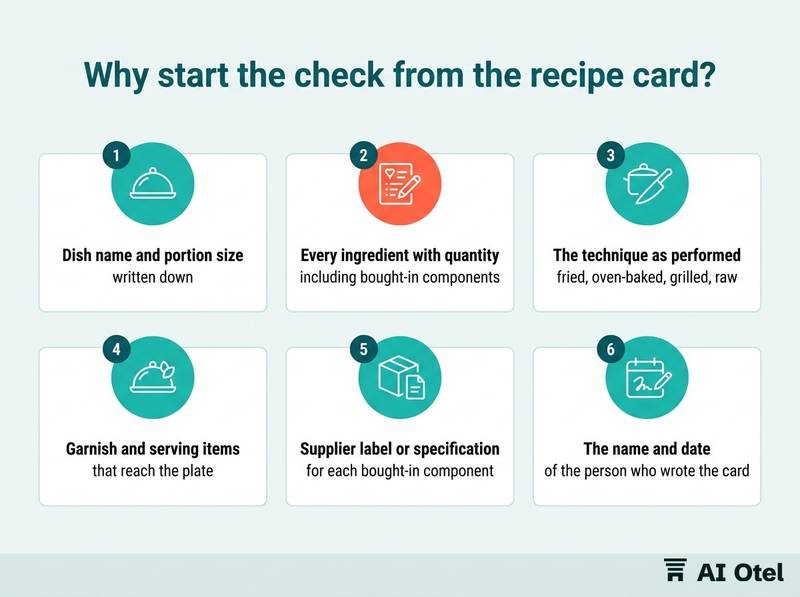
If the dish has no written card, write it before anyone writes the menu: ingredients with quantities, the technique as performed, the garnish that reaches the plate, and every bought-in component such as stock, sauce, pastry, dressing or ice cream. Bought-in components bring their own ingredients and their own claims. Check them against the supplier's label or specification, not against the recipe's reputation.
Give the AI assistant the recipe card as its only source and tell it to use nothing else. Do not hand it last year's menu text, which may already carry the error forward. Then compare in both directions: every ingredient named in the text must be on the card, and every ingredient on the card that a guest would notice must appear in the text.
Watch grades and forms, because they change what the guest is told: truffle oil against truffle, cream against a cream substitute, fresh against frozen, whole nuts against nut paste. The card is also the version record. When the recipe changes, the card changes, and the menu text is rechecked against the new version rather than patched by memory. The same discipline applies when you are planning a weekly hotel menu with an AI assistant: the cost limit and the stock on hand are also facts the assistant cannot guess.
ChecklistBefore the AI writes a word, have these written down
- Dish name and portion size written down
- Every ingredient with quantity, including bought-in components
- The technique as the kitchen performs it (fried, oven-baked, grilled, raw)
- Garnish and serving items that reach the plate
- Supplier label or specification for each bought-in component
- The name and date of the person who wrote the card
Who writes the allergen line?
The chef does, from the recipe card and the supplier labels, and signs it. An AI assistant may format the line, but it never decides what goes in it.
The allergen line is a statement of fact about a dish, so it needs one owner per kitchen: a named person, not a role that everyone assumes someone else fills. Build it from the card and the supplier specifications, not from memory and not from a suggestion the assistant offers.
Decide the house rule for the kitchen itself: shared fryers, shared boards, shared grills. Whatever the kitchen does, say it in the same words every time, and let the chef set those words. Where the kitchen cannot be certain, the line says so plainly. A guest who is told to ask can ask; a guest who is told a dish is free from something cannot.
An incomplete list is worse than a short honest one, and a generated list looks complete whether it is or not. Keep the same line on the printed menu, the QR menu, the guest app and the buffet card: one dish, one line, one owner. The same one-line rule applies to QR menus and the printed list rule, where every copy of the menu has to agree with the printed list.
Key pointOne dish, one allergen line, one owner
If the printed menu, the QR menu and the buffet card disagree, the guest is right to trust none of them.
Confirm your own allergen obligations, wording and record keeping with a legal adviser or the authority that regulates your kitchen. The practice above is about getting the fact right, not about what the law requires.
Which wording claims need proof?
Any word a guest could hold you to. Homemade, local, fresh, gluten-free, vegan, sugar-free, aged, organic, traditional and chef's own are all promises, and each one needs something the kitchen can show.
Sort the claims into three groups, because each is proved differently: what the kitchen does (homemade, hand-cut, wood-fired), where it comes from (local, regional, from a named town), and what it does not contain (gluten-free, dairy-free, vegan, no added sugar).
Write the house definition of the words you use most. Homemade can mean made on site from raw ingredients or assembled on site from bought components; pick one and apply it on every menu. Local needs a distance or a named area agreed once with purchasing, so that a change of supplier does not silently break the claim. A free-from claim depends on the bought product's specification as much as on the recipe: a sauce, a stock or a shared production line can undo it.
Delete a claim you cannot support rather than softening it. "Carefully selected" reads as filler and invites the same question as "local". The AI assistant produces these words readily because they sell. That is exactly why each one goes on a short list for the chef and the purchasing manager to confirm before print. The same habit of confirming claims against evidence, not against how the text reads, is the basis of the honesty checklist for AI-generated hotel images.
| Claim | What the guest hears | What the kitchen must be able to show |
|---|---|---|
| Homemade | made here, today, from basic ingredients | the production step on the recipe card, who performs it, and a written house definition |
| Local | from nearby, from this region | the supplier and the origin on the invoice or the supplier's own statement |
| Fresh | not frozen, not long-stored | the purchasing rule and the delivery record |
| Gluten-free or vegan | nothing of that kind in it | the supplier specification for each bought component plus the chef's check of the recipe |
| Traditional or chef's own | a known recipe or a personal one | the source the kitchen names, or the word is dropped |
| Grilled or wood-fired | that technique was used | the technique line on the recipe card |
How do you check a translated menu description?
Treat the translation as a new description and run the whole check again, because the words that carry ingredients and claims rarely survive a machine translation intact.
A translation reads as authoritative to a guest who cannot check it, and a wrong word is invisible to a manager who cannot read that language. Ingredient names are the weak point: the same fish, cheese or nut carries different names in different languages, and some names cover a family of products rather than one.
Qualifiers carry the highest risk: "may contain", "not suitable for" and "free from" can be softened or dropped while the sentence still reads well. Have the translation read by someone who cooks or serves in that language, not only by a speaker of it. The kitchen's vocabulary is not the classroom's. The same care applies when checking a Turkish AI draft written for guests, where formality and hotel terms also need a person's eye.
Keep a one-page glossary per language: dish names, ingredient names, and the exact wording of your allergen and free-from lines. Give it to the assistant together with the recipe card. The chef looks at the translated allergen line last, because the chef owns the fact even when someone else owns the words.
TipOne glossary page per language
Keep one glossary page per language and reuse it on every reprint. It is the only reliable way for the same dish to say the same thing in five languages.
How do you record an approved menu text, and when do you reprint?
Keep one approved version per dish with the date, the approver's name and the recipe version it was checked against, and reprint when any of those three changes.
The record can be one line in a shared sheet: dish, language, approved text, recipe version, allergen line, claims confirmed, approver, date. The reprint triggers are events, not a calendar: a recipe change, a new supplier or a changed supplier specification, a new language, a new outlet, a seasonal menu change, a guest question about a dish.
The printed menu, the QR menu, the guest app and the buffet labels are four copies of one fact. Update them together or they will disagree in front of a guest. Keep the old versions. If a guest raises something weeks later, you can show what the menu said on the day.
Make the recheck cheap: the same card and the same checklist take minutes, which is the practical reason to write the card in the first place. Give the trigger to a role, not to goodwill: whoever changes the recipe tells whoever owns the menu text the same day, and the approver signs the new version.
ChecklistReprint and recheck when any of these happen
- The recipe changes
- A supplier changes or a specification changes
- A new bought-in component enters the dish
- A new language is added
- A new outlet, buffet or banquet menu uses the dish
- The seasonal menu changes
- A guest asks a question or makes a complaint about the dish
- The kitchen's cross-contact practice changes
What to do next
Pick one dish tonight: write its recipe card, rebuild its description from the card alone, and have the chef write and sign the allergen line. Then record the approved version with a date and a name. The three steps are the same for every dish, every language and every reprint, and they are what turns an AI draft into a menu line the kitchen can stand behind.
If you are a traveler rather than a hotel professional, you can use the same logic from the other side: when a menu makes a claim, ask the staff what stands behind it. To find a hotel in Türkiye (opens in a new tab), start with the properties that answer that question plainly.
Frequently asked questions
Can an AI assistant draft the allergen line if the chef checks it afterwards?
It can format a line the chef has already decided, but it should not draft the content. A generated list looks complete, and a checker tends to confirm a list rather than rebuild it from the card and the supplier labels. The chef writes the line from the recipe card and signs it.
Our kitchen has no written recipes. Where do we start?
Start with the dishes that carry the most claims or the most bought-in components, usually desserts, sauces and breakfast items. Write one card per dish: ingredients with quantities, technique, garnish, bought-in components with their labels. A handful of cards covers much of a small menu, and the rest follow the same pattern.
Is AI translation good enough for a menu in several languages?
Good enough as a draft, not as a final. A person who cooks or serves in that language reads it, a glossary keeps dish and ingredient names consistent, and the chef approves the translated allergen line. The check is the same one used for the original text.
How often should menu text be rechecked?
On events rather than a fixed calendar: a recipe change, a new or changed supplier, a new language or outlet, a seasonal menu, or a guest question about a dish. A fixed review at each menu change catches what the events miss. This is the AI menu description allergen check hotel kitchens should treat as routine, not as a one-off.
What if we cannot prove a claim like homemade or local?
Remove the word rather than softening it. A softened claim invites the same question and answers none of it. If the kitchen can show the production step or the supplier's origin, keep the word and write down in the house what it means.