One sheet of opening hours and house rules: so the desk and an AI assistant give guests the same answer
A single dated facts sheet ensures the desk, website and AI assistant give guests identical answers on hours, rules and prices. This guide covers ownership, change checks and weekly spot checks to prevent drift.
Contents
Key takeaways
- A guest who gets three different pool hours stops trusting all three, so the fix is one page, not three corrections.
- Every line on the sheet needs an owner role and a review date; a fact with no owner drifts within a season.
- The assistant should answer only from the sheet and hand anything outside it to a named person, saying so plainly.
- A change is finished only when the website, the printed desk copy and the assistant's source all show the new version.
- A ten-minute weekly spot check of five real guest questions catches drift before a guest does.
A hotel facts sheet for AI assistant use, the desk and the website is one dated page of opening hours, house rules and extra prices, with a named owner and a review date on every line. All three answer from that single page, so a change reaches every reader on the same day.
A guest reads the pool hours on the website, asks the desk on the way up, and asks an AI assistant on the hotel's own page. If the three answers differ by an hour, the guest does not blame the website. They conclude the hotel does not know its own building. This article shows how to build one facts sheet that every answer comes from, who owns each line, how a change reaches all three places on the same day, and what the assistant must never answer at all.
Where do guest answers start to diverge?
They diverge the moment a fact changes in one place and not in the others. The website is edited once at launch, the desk learns by word of mouth, and the assistant reads whatever document it was last given.
Three copies usually have three editors. Marketing owns the website page, the front office manager owns the shift handover, and whoever set the assistant up owns its source document, usually without knowing it. Nobody is doing anything wrong; each person is maintaining their own copy in good faith.
Hours drift first. A pool that opens an hour later outside high season stays at the old time on the website and in the assistant's source for months. Rules drift the same way: a pet policy tightened after an incident lives in the desk's memory and nowhere else, so the assistant keeps welcoming dogs. Extra prices are the most expensive drift. A late checkout quoted at one price at the desk and another on the website becomes an argument at departure, in front of other guests.
The guest does not compare sources. They act on the first answer they get and complain at the second, which is why the complaint lands at the desk for a mistake made on the website. An assistant makes the problem louder, not because it is wrong more often, but because it answers in complete, confident sentences, and a guest reads confidence as authority. If you are setting up an assistant, the same discipline applies to how AI assistants describe your hotel and keeping facts consistent.
NoteConfidence is the problem
A wrong answer from a person sounds uncertain and invites a second question. A wrong answer from an assistant sounds final, so the guest stops asking and acts on it.
The fix is not more training or another briefing. It is one page that all three readers read from, and a rule that nothing guest-facing is answered from anywhere else.
What belongs on the facts sheet?
Opening hours, house rules and the prices of extras, plus the practical answers guests ask for that are neither. One line per fact, written as the answer itself, not as a topic.
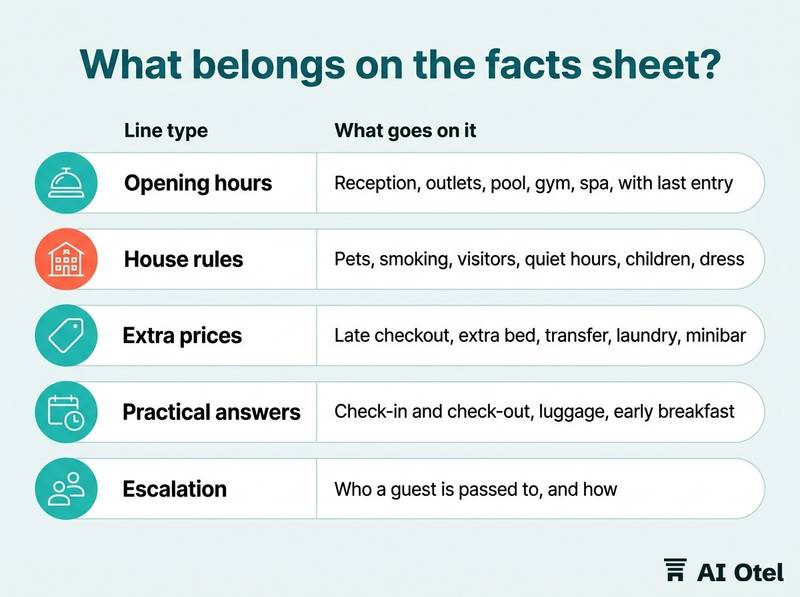
Hours cover reception, breakfast, restaurant, bar, pool, gym, spa, laundry, room service and parking. Give each one the last entry time as well as the closing time, because the last entry is what the guest actually needs. Rules cover pets, smoking, visitors and day guests, quiet hours, children in the pool or spa, dress in the restaurant, pool towels, and any limit staff enforce but have never written down. Extra prices cover late checkout, early check-in, extra bed, crib, breakfast for a visitor who is not staying, airport transfer, laundry, and the water in the minibar.
Practical answers belong on the sheet too: check-in and check-out times, luggage storage after check-out, whether breakfast can be served before an early tour departure, step-free access, and where a guest can charge a car.
Write the answer, not the topic. "The pool is open 09:00 to 20:00; last entry 19:30" beats "Pool: ask at reception". Put the exception on the same line, because an exception kept in someone's head is the fact that breaks.
| Line type | What goes on it | Who usually owns it | How often it changes |
|---|---|---|---|
| Opening hours | Reception, outlets, pool, gym, spa, with last entry | Outlet or front office | With the season |
| House rules | Pets, smoking, visitors, quiet hours, children, dress | Front office or GM | Rarely, after incidents |
| Extra prices | Late checkout, extra bed, transfer, laundry, minibar | Revenue or front office | A few times a year |
| Practical answers | Check-in and check-out, luggage, early breakfast, access | Front office | Rarely |
| Escalation | Who a guest is passed to, and how | Guest relations | Rarely |
Keep it to one page, and hold a version in each language the desk actually serves. Translate from the master rather than from another translation, have a person read the result, and date the translation as well as the original. If your assistant answers in Turkish, the checking step matters as much as the writing: see checking Turkish AI drafts for guests, the formal siz and hotel terms.
Leave out anything that changes by the booking: room availability, room rates, and which room a guest will get. Those belong to the reservation system, and a sheet that repeats them creates a second, weaker source.
Who owns each line, and when is it reviewed?
The department that has to enforce a line owns it, and every line carries an owner role and a review date. A fact with no owner is a fact that will be wrong by next season.
Record the owner as a role plus the current holder, for example front office manager with a name beside it, so the sheet survives a resignation or a transfer. Give every line a deputy, because the owner will be on leave in the week the pool hours change.
Set a review date per line rather than one date for the page. Prices move more often than rules, and hours move with the season. Name the triggers for an out-of-cycle review: a season change, a price change, a new rule after an incident, a renovation, or a new outlet opening.
Have the general manager sign the page once and each department head sign their own lines, so that a rule on the sheet is a rule the hotel has actually decided. Keep a version number and a short change log at the bottom: what changed, on what date, and who changed it. Put the version date at the top of the page, where a guest-facing reader sees it before reading anything else.
ChecklistBefore the sheet goes to the desk and the assistant, run this sign-off check
- Every line has an owner role and a named holder
- Every line has a review date
- Every line has a deputy
- The last change is logged with its date
- The general manager's sign-off is recorded
- The printed desk copy carries the same version number as the master
How does a change reach the website, the desk and the assistant on the same day?
One master copy, one edit, and a change that is not closed until all three readers show the new version. The order matters less than the closing check.
Keep the master in one place that a named person edits. Everything else, the website page, the desk printout and the assistant's source, is a copy and is labelled as one. Print the desk copy with the version date on it, and destroy the previous printout on the same shift, the same discipline that keeps a printed menu and a QR menu from disagreeing, as covered in the printed list rule for QR menus and price updates.
Edit the website page from the master rather than rewriting it in the site's own words, because a rewrite is a second author and a second author is a second truth. Point the assistant at the same document. Do not maintain a separate FAQ for it, since two documents will disagree within a season and nobody will know which one the guest saw.
Open a change ticket that lists the three places and closes only when someone has looked at each one. A ticket that closes on the edit, not on the check, is how drift starts. Name the checker and the deadline: the shift supervisor confirms all three at the next handover, and writes the confirmation into the log.
The most common failure is quiet. The assistant's source is a document from last year that nobody remembers uploading, and it is still answering from it.
TipThe working rule
Change one line, check three places, write the date. The check is the step that gets skipped, so it needs a name against it.
What must the assistant not answer?
Anything that is not on the sheet, and anything that is a commitment rather than a fact. The assistant answers from the page and hands everything else to a person.
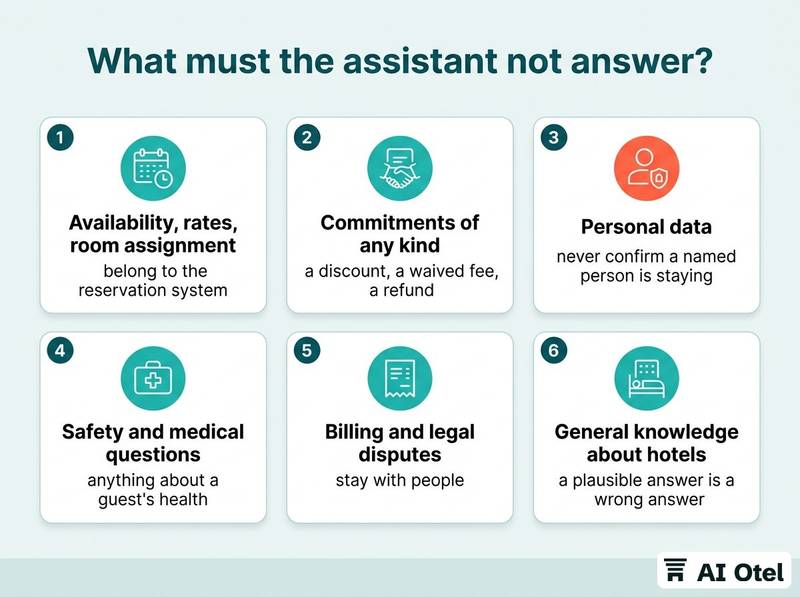
Availability, rates and room assignment belong to the reservation system, not to a facts page, and an assistant that improvises a rate has made a promise the hotel has to honor or refuse in public. The same applies to commitments of any kind: a discount, a granted late checkout, a waived fee, a refund, a guaranteed quiet room, or a resolution to a complaint.
The assistant must never handle personal data. It should not confirm whether a named person is staying, read back a bill, or repeat an identity detail a guest has typed. Keep safety and medical questions, anything about a guest's health, and anything involving a child without an adult present, with people. Billing and legal disputes stay with people too, along with any question that begins with what a guest says they were promised on the phone.
The handover must be explicit. The assistant says a person will take over, and passes the question, in the guest's own words, to a named desk queue rather than a general inbox. And the assistant must not fill a gap from general knowledge about hotels. A plausible answer about what hotels usually do is a wrong answer about this one, and the guest will hold this hotel to it.
Watch outThe failure mode that matters most
An assistant that guesses to be helpful turns a missing line on the sheet into a promise at the desk, and the desk has no record of having made it.
What does a weekly spot check look like?
Ten minutes, five questions guests actually asked this week, put to the desk, the website and the assistant, and compared on the facts that matter.
Take the questions from the desk's own log of what guests asked, not from a list written in the office, because the office list tests the sheet and the log tests the guest's experience. Compare times, prices and yes-or-no rules word for word. Ignore tone and phrasing; a friendly answer with the wrong closing time is still wrong.
Fix the master, never the copy. If the website is corrected and the master is not, the same error returns at the next update. Log every mismatch with its date and the line it came from, so that over a season the log shows which lines drift, and those lines earn a shorter review date. Rotate who runs the check, so it does not depend on one person's memory or one person's week off. Ask the assistant in each language the hotel sells in, because a translation drifts on its own schedule and the guest reading it will not tell you.
ChecklistThe ten-minute check
- Pick five questions from this week's desk log
- Write the correct answer from the master
- Ask the desk, open the website page, ask the assistant
- Mark each of the three as match or mismatch
- Log the mismatches with the date
- Correct the master
- Confirm the three copies at the next handover
What to do next
Take five questions the desk answered this week, write the answers as lines on one dated page, and give each line an owner and a review date. Then read the website and the assistant against that page before the next shift, and repeat the check weekly. The sheet is the cheapest part of making an assistant trustworthy, and it needs no software change to start.
If you are reading this as a traveller rather than a hotel professional, you can browse hotels across Türkiye (opens in a new tab) and see the difference a hotel that knows its own building makes.
Frequently asked questions
Should the hotel facts sheet be a PDF or a web page?
The format matters less than having one master that a named person edits and that the desk and the assistant both read. A dated, versioned PDF works as a master; a page edited in one place and read everywhere is easier to keep current. What fails is two documents, whatever their format.
Who should write the house rules on the sheet?
The department that enforces the rule writes it, and the general manager signs it. Rules drafted by marketing tend to be softer than what the desk actually applies, and the gap between the two is what a guest experiences as being told different things.
How often should the sheet be reviewed?
Set a review date per line rather than one date for the page: prices move more often than rules, and hours move with the season. Add triggers for an early review, such as a season change, a price change, a renovation or a new rule after an incident. The review date being visible matters more than the interval chosen.
What should the hotel do when the assistant and the desk disagree?
In the moment, the desk is right and the guest is answered by a person. The master is then wrong, so correct the master the same day, log the mismatch with its date, and confirm the website and the assistant at the next handover. Correcting only the copy guarantees the error returns.