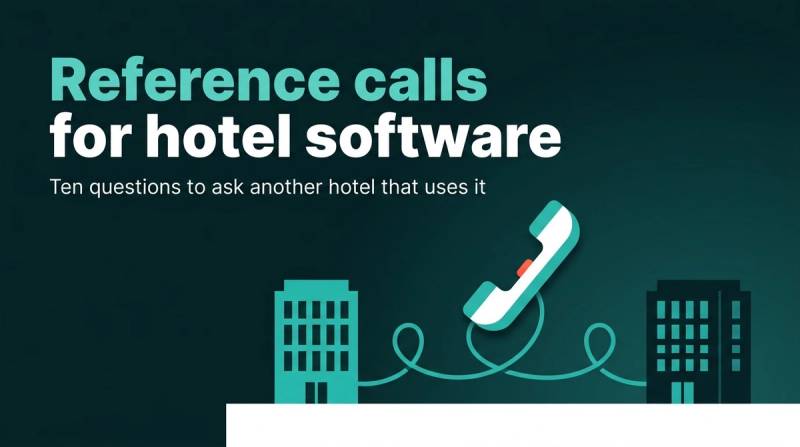
Reference calls for hotel software: ten questions to ask another hotel that uses it
A demo shows the happy path, but a reference call reveals the ordinary week. Learn ten questions to ask other hotels about support, downtime and migration to compare vendors with facts.
AI draft · awaiting editorial review
Contents
Key takeaways
- A demo shows the product on prepared data; a reference call shows the ordinary week, including the failures.
- Choose at least one reference yourself, and ask the vendor for a hotel that stopped using the system.
- Ask for incidents, names and durations rather than opinions: a good answer contains a date, a person and a workaround.
- Record every call on the same one-page sheet, so three conversations compare like three offers.
- The most useful question comes last: what would you do differently, and would you sign the same contract again?
A hotel software reference call questions another hotel that already runs the system, ideally one you chose rather than the vendor. Ask ten questions about support, downtime, month-end, integrations, migration, training and hidden costs, record every answer on the same sheet, and compare hotels of similar size and segment before you sign.
The demo runs on clean data, the presenter never hesitates, and every screen behaves. The decision you are actually making is about a Saturday night in August, when the card encoder stops working and the reception queue reaches the door. After reading this, you will be able to run two or three reference calls that produce facts instead of politeness, and compare them beside the offers on your desk.
Why is a vendor demo not enough?
A demo is a sales event with a script and a time limit, so it shows the happy path. A reference call is where you hear the same product described by someone who has no reason to be polite.
Demo data is prepared: guest profiles are complete, rates are tidy, and nothing is half-finished. Your data will arrive messy, with duplicate profiles and open balances. The person demonstrating is usually the most fluent user of the system in the company, while your receptionist will be the least fluent user on day one.
A demo answers "can it do this?". It cannot answer "what happens when it does not?", which is where support, workarounds and the real cost of ownership live. Ask the vendor to show the exact version and modules you would buy; a feature shown from a different edition tells you nothing about your contract.
The two conversations are different jobs. Settle scope, price and contract shape first, using the questions to ask vendors before you reach the reference stage, then test the claims with a customer. A demo shows features. A reference hotel shows workarounds, the spreadsheet still running beside the system, and the module nobody opens.
How do you find a reference the vendor did not choose?
Ask for a list rather than a name: request every customer in your segment and size, then pick the ones you call. A vendor-chosen reference is still useful, but it is a curated one.
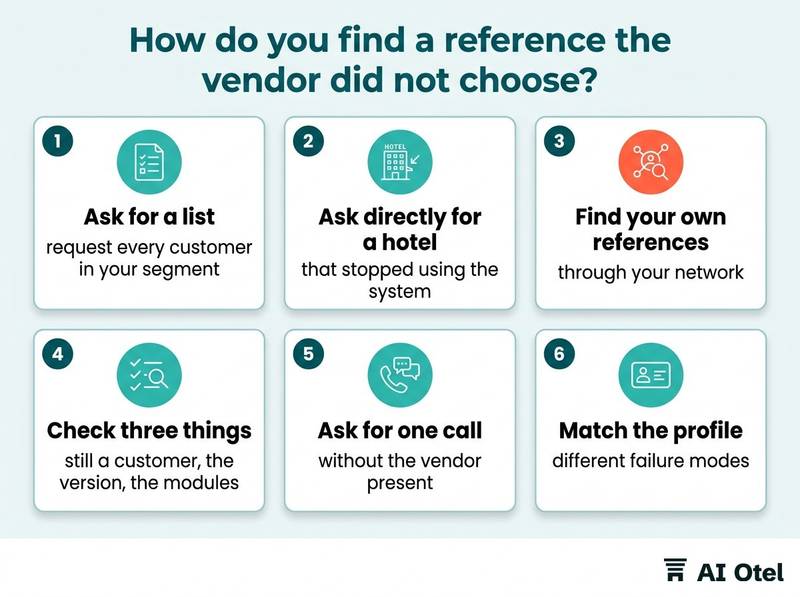
Ask directly for a hotel that stopped using the system, or downgraded it. Former customers describe the exit, and the exit is what you are protecting yourself against. If the customer list in your segment is short, that is information too.
Find your own references through your network: neighboring hotels, chain colleagues, your accountant's other hotel clients, your local hotel association. A hotel with nothing to gain answers differently. Ask whether they received anything for taking the call, such as a discount or an extension; it does not disqualify them, but it changes how you weigh the answers.
Before you dial, check three things: that the reference is still a customer, that they are on the version you would buy, and that they run the modules you need. A hotel two releases behind is describing a different product. Ask for one call without the vendor present, and for a conversation with the person who uses the system daily, not only the owner or the IT lead. Match the profile: a 400-room resort and a 30-room boutique have different failure modes, and a reference from the wrong segment can mislead in both directions.
What are the ten questions, and what does a good answer sound like?
Ask about events, not impressions. A good answer names a person, a date, a duration and what they did instead while the system was not working.
| Question | A good answer sounds like | Treat this as a warning |
|---|---|---|
| 1. Walk me through your last month-end close: who does what, how long? | A named person, a sequence of steps, an approximate duration, what they check before closing | "It is all automatic" |
| 2. What broke in the last three months, and who fixed it? | Two or three named incidents with time to fix | "Nothing breaks" |
| 3. You send a support ticket: what happens next, and how long until a person answers? | Severity levels, first response, who replies, how to escalate | "Support is great" |
| 4. Has the system ever been unavailable during a shift? | The fallback used, how long, how data was re-entered | "Never happened" |
| 5. Which parts do you not use, and why? | A named module and what replaced it | "We use everything" |
| 6. How did the data migration go, and who did the work? | Who extracted the data, how many attempts, what did not transfer | "It was smooth" |
| 7. How long before your team was confident, and what did training look like? | Weeks, who was trained, who struggled | "A couple of days" |
| 8. Which integrations run in production, and which were given up on? | Named systems, plus which links are still manual | "Everything integrates" |
| 9. What does it cost beyond the license, in people, add-ons and workarounds? | Extra staff time, an added module, a spreadsheet still running | "Just the subscription" |
| 10. What would you do differently, and would you sign the same contract again? | A specific clause they would change or a step they would add | "No regrets" |
Question six deserves a follow-up: ask specifically what did not come across, such as guest history or city ledger balances, because that is where migration pain hides. Question three is where you compare what you hear against the support and uptime terms in the contract, including response time and recovery targets. If you are unsure what a ticket, a severity or an escalation means in practice, read up on what a ticket, a severity, a workaround and an escalation mean before the call, so you can follow the answers.
What should you ask about the first month and the first season?
The first month decides whether your team trusts the system, and the first high season decides whether it holds. Ask about both as timelines, not as opinions.
Ask what ran in parallel with the old system, for how long, and who decided it was safe to stop. Parallel running is a cost most buyers forget to budget. Ask who was on the floor on the first night and who they called when something went wrong at 23:00; that answer tells you what support actually looks like outside office hours.
Ask how the first month-end close compared with the old one: who checked the numbers, what did not balance, and how long it took to find out why. Ask what the first high season changed: what broke under load, what they fixed before the next season, and what they still avoid doing at full occupancy.
Staff turnover is normal in this industry, so ask how long a new receptionist takes to become safe on the system, and what training exists for the second wave of seasonal staff. That answer matters more than the first training session. Ask what they prepared before cutover that they would prepare again, and what they would skip; this is the cheapest planning advice you will get. Finally, ask what still lives outside the system: a spreadsheet, a paper book, a messaging group. That list is your real gap analysis.
TipAsk for a timeline, not a verdict
Ask the reference to describe the first two weeks day by day, rather than as a verdict. Timelines produce facts; verdicts produce politeness.
How do you record and compare answers from several hotels?
Use one sheet, the same ten questions in the same order, for every call. Consistency is what turns three conversations into evidence you can put beside three offers.
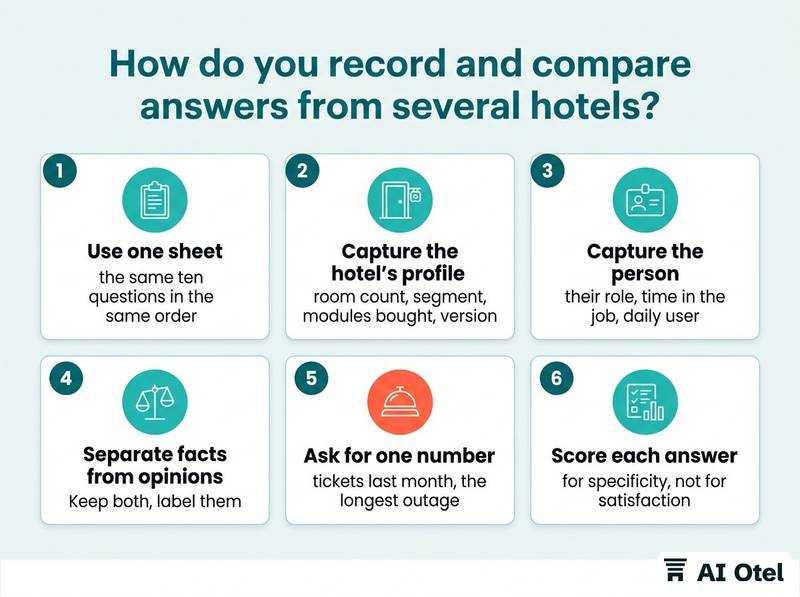
Capture the hotel's profile first: room count, segment, modules bought, version, and whether they are still a customer. Without it, the answers cannot be compared. Capture the person: their role, how long they have been in the job, and whether they use the system daily. A daily user and an owner describe different products.
Separate facts from opinions on the sheet. "The longest outage was about four hours on a Saturday" is a fact; "support is slow" is an opinion. Keep both, label them. Ask for one number wherever a number exists: tickets last month, the longest outage, days to close the month. Approximate answers are still comparable; vague ones are not. Score each answer for specificity, not for satisfaction, so you are comparing the quality of evidence rather than how much the hotel liked the vendor.
Checklist
- Date and duration of the call
- Hotel profile: rooms, segment, modules, version, still a customer or not
- The person spoken to: role, time in the job, daily user or not
- The three incidents they named, with dates and time to fix
- The last month-end close in steps and hours
- The live integrations and the manual ones
- The cost beyond the license
- Two or three verbatim quotes
- A specificity score from 1 to 5
- What they would do differently
Write two or three verbatim sentences per call. Quotes survive the meeting; your memory of the meeting does not. Then put the completed sheets next to the contract's support and uptime terms, and note every place where the sales promise and the customer experience diverge. If you want the sheets to line up with the offers themselves, build them on top of a requirements document that makes vendor offers comparable.
What are the red flags in a vague answer?
Vagueness is usually politeness, not deception, but it costs you the same. Treat an answer with no person, no date and no mechanism as an unanswered question.
Watch for praise without a mechanism: "it just works", with no example of a problem and how it was solved. Watch for no names, no dates and no durations anywhere in the call, even after you ask twice. Watch for the vendor answering the technical questions while the hotel agrees with whatever is said, and for a reference who cannot describe a single support ticket, which usually means they have not needed one, or they call someone else first.
Check the profile again: a reference much larger or smaller than you, in a different segment, or on a version you would not be buying, is describing a different product. If the answers repeat the sales deck word for word, including the same phrases about ease of use, you are hearing marketing, not experience. And if the modules you need are the ones they do not use, you are about to be the first real test of that part of the product.
Watch outFour phrases and what they may hide
"It is smooth" may hide a manual step someone does quietly. "Support is excellent" may hide that they have never escalated. "We do not use that module" may mean the module does not work in their setup. "I cannot say anything bad" may mean they were given something for the call.
What to do next
Write the ten questions onto one page, book two calls, one reference you chose and one the vendor chose, and hold both before you sign anything. Then place the completed sheets beside the contract's support and uptime terms: the gap between the promise and the customer's ordinary week is the risk you are actually buying. If you are also evaluating what a modern hotel operating system looks like on paper, the platform overview of a hotel operating system and the trust and status page show how one vendor states, in writing, what is built, what is in testing and what is planned, which is exactly the standard your reference calls should hold every vendor to.
Frequently asked questions
Should the vendor be on the reference call?
Ask for at least one call without them, because hotels are more candid about failures when the salesperson is not listening. If the vendor insists on joining, accept one joint call and one alone, and ask the same ten questions in both so you can compare the two versions of the same story.
How many reference calls are enough?
Two or three is usually enough to see a pattern, provided they differ in size or segment so you are not hearing one hotel's habits. Add one former customer if you can find one, since the exit story is the one a current customer will not tell you.
What if the vendor has no reference in my segment?
Treat the absence as information and ask what it means: a new market, a new product line, or a product that does not fit your operation. Ask for the nearest comparable property, for a former customer, and for a supervised visit. If none exists, ask for exit terms and a defined review point in the contract instead.
How long should a reference call take?
Plan 30 to 45 minutes with two people from your side: one asks, one writes. Send the ten questions in advance so the hotel can check its own records, and leave the last five minutes for the question you did not plan.
Can I ask a reference hotel about its contract and price?
You can ask, and they can decline. Their commercial terms belong to them, so ask what they are comfortable sharing and keep the focus on their experience of the system. What you need is the shape of the deal, such as what was included and what was charged extra, not their negotiated figure.