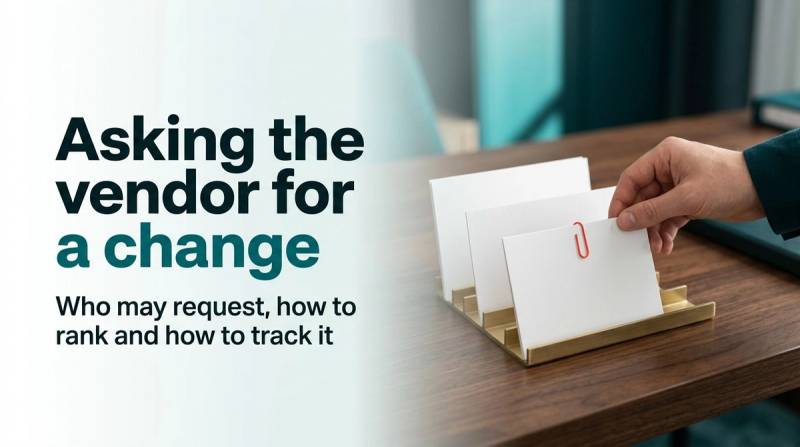
Asking the vendor for a change: who may request, how to rank and how to track it
A change request is a written ask for new behavior, distinct from a support ticket. Learn who may request changes, how to rank them by the cost of waiting, and how to track decisions with your software vendor.
AI draft · awaiting editorial review
Contents
Key takeaways
- A bug goes to support as a ticket and a wish goes to the change log; running both through one queue is why each feels ignored.
- One named collector, with a named deputy, keeps the list short enough to rank and stops six departments emailing the vendor separately.
- A request without the problem, the people affected, the frequency and the workaround cannot be ranked, tested or closed.
- Rank by the cost of waiting, meaning what the hotel loses each month the change is absent, not by who asked loudest.
- A request is closed when the person who raised it confirms the new behavior in their own work and the written procedure has been updated.
A change request is a written ask to your software vendor for behavior the system does not have yet. One named person collects them, each states the problem, who is affected and how often, ranking uses the cost of waiting, and a monthly meeting with the vendor decides what moves. This is the whole software change request process for a hotel, and it fits on one page.
The front desk manager has asked for the same thing three times this year: a way to split one bill between two companies. It sits in a chat thread, an email and somebody's notebook. The vendor has never received it as a request, so it has never been ranked, priced or declined. After reading this you will be able to write your hotel's one-page rule, open a log the same day, and run the first monthly meeting with a list the vendor can actually act on.
What is a change request in hotel software?
A change request asks the vendor to make the system behave differently from today. A support ticket reports something broken or asks how to use what already exists. The difference sounds small. It decides who owns the item, how it is measured, and what closes it.
The three queues: incident, question, change
A hotel actually has three queues. An incident means something is broken now and work has stopped. A question means someone wants to know how to do something in the system. A change means new or altered behavior, including a removal or a setting that should be switched on.
The queue is decided by the person who receives the call, not by the person who complains. Otherwise every wish arrives as an emergency and every emergency is filed as a wish. This matters because the two queues are measured differently: support desks are measured by response and resolution, so a wish sent to support is closed as "not a fault" and disappears, while a fault sent to the change log is ranked as a low wish while it is costing money today.
A change is not only a new screen. It can be a report column, a permission, a rounding rule, a message text or the removal of a step nobody uses. Write the split into the hotel's own rule in one page, because the difference is invisible at the moment someone is frustrated at the desk, and tell the vendor which queue you are using when you write, so their side does not have to guess and re-route. For the vocabulary of the support side, see the support words a hotel team needs: ticket, severity, workaround, escalation.
| Support ticket | Change request | |
|---|---|---|
| What it reports | Something broken, or a how-to question | Behavior the system does not have yet |
| Who owns it | The support desk, measured to resolution | The hotel's collector, measured to a decision |
| How it is measured | Response and resolution time | Decision, date and cost of waiting |
| What closes it | The fault is gone or the question is answered | The raiser confirms the new behavior; the procedure is updated |
| Time horizon | Hours to days | Weeks to a release window |
Who may request a change, and who decides?
Anyone may raise a change request; one named person collects them; a small group decides which go to the vendor. The collector checks completeness and duplicates, not whether the idea is good.
Open the right to raise as wide as the work. Housekeeping, night audit, the restaurant, sales and the front desk all see problems that never reach a manager's desk. Name one collector and one deputy, usually the IT lead or the general manager's assistant, so a request cannot die in a personal inbox during a holiday.
The collector does four things only: confirm the request is complete, merge duplicates, give it a number, and put it on the list for the next review. Keep the decision group to three: the head of the department affected, the person who owns that process, and whoever holds the vendor relationship. Stop department heads emailing the vendor directly; the vendor then holds several lists and ranks by whoever called most recently, which is not a ranking at all.
Write the rule down: who may raise, who collects, who decides, how often the list is reviewed, and where the log lives. A one-page rule beats good intentions in August. Review the log weekly for five minutes and monthly in full; a list nobody reads is a complaint file with better formatting.
ChecklistThe one-page rule, as tick boxes
- One named collector and one deputy are written down
- Every department knows the collector's address
- The three-person decision group is named
- The log has one home that everyone can read
- The weekly five-minute review is in a calendar
- The monthly vendor meeting has a fixed date
- The rule says a request without a problem statement is returned, not rejected
How do you write a change request the vendor can act on?
State the problem, who is affected, how often it happens, what people do instead today, and what done looks like. Leave the solution to the vendor unless you already know it.
Write the problem, not the button. "We cannot split one bill between two companies" gives the vendor room to solve it properly, while "add a split button" may name a solution that already exists as a setting. Name who is affected and how often: which role, how many people, how many times a week or a month. Frequency is what separates a daily irritation from a yearly one.
Describe the workaround and its cost in minutes and errors. The workaround is the strongest evidence a request can carry, because it is already being paid for. Write the acceptance sentence: what the person will be able to do after the change that they cannot do now. This sentence is what you test against later.
State what must not change: the fiscal document, the guest identity notification, the night audit close, a report the accountant relies on. A change that breaks one of these costs more than it saves. Attach evidence with no guest personal data in it: a screenshot of the screen, an exported report, a sample bill with the names removed. Keep the solution field optional and clearly marked, so a good idea from the desk is not lost but also not treated as a specification.
The six fields of a usable request
TipThe six-field template the collector enforces
1) The problem in one sentence. 2) Who is affected and how often. 3) What people do instead today, and what that costs in minutes and errors. 4) The acceptance sentence, what done looks like. 5) What must not change. 6) Evidence attached, with guest personal data removed. A request missing fields 1, 2 or 4 is returned to the raiser, not declined.
How do you rank change requests?
Rank by the cost of waiting: what the hotel loses each month the change is absent. Reach, frequency and the size of the loss per occurrence give you a rough score you can defend.
Score three things and multiply them roughly: how many people or guests are touched, how often it happens, and how large the loss is each time. Precision is false here; order is what you need. Put the loss in the units the hotel already argues in: hours of rework per month, charges posted by hand, a room type that cannot be sold, a report rebuilt in a spreadsheet every Monday.
Break ties with three questions: does it block a legal or fiscal step, does it have to be in place before a season starts, and does it unblock other requests on the list. Do not rank by the seniority of the asker; a general manager's wish and a night auditor's nightly correction need the same three numbers before either moves. Keep a "not now" pile with a review date instead of a bin; a request that returns every quarter is evidence that the cost of waiting was underestimated. Rank against your own workaround cost, not against an imagined list of other hotels. You can see your month, and you cannot see the vendor's other clients.
Key pointA worked, clearly hypothetical example
For example, a change that saves the night auditor 20 minutes a night is about 120 hours a year, while a change that lets the sales team confirm a group without a phone call removes a delay on every group booking. Score both in the same unit, hours and money per month, and the list ranks itself without an argument about who shouted first.
What happens in the monthly meeting with the vendor?
A fixed monthly slot with a written agenda, one decision per request, and a named owner on each side. The meeting sets priority; the contract sets the service terms.
Send the list three working days ahead so the vendor's side arrives with an answer rather than an impression, and so their engineers have already looked at the request. Open with last month's decisions: what was accepted, did it ship, did it work. A meeting that never checks the previous month teaches everyone that decisions are cheap.
Allow exactly three outcomes per request: accepted with a target window, deferred with a review date, or declined with a reason. "We will look at it" is not a decision and must not be recorded as one. Ask what the change touches: other modules, the fiscal document flow, the guest identity notification, the reports, the interface your staff already learned. A change is rarely local.
Ask for the cost on your side too: testing time, retraining, the written procedure that must be rewritten, the week when the desk is short-staffed. Record the vendor's answer in the same log, next to the request, so the decision survives the people who attended the meeting. Agree the high-season window in advance: a change accepted in June may have to wait, and it is better to say so in March than to argue in July.
Priority is not the same as the service level
A decision in the monthly meeting says the change matters and in what order. It does not say how fast the vendor must respond when something breaks; that is the support agreement, and the two should never be confused. For the contract side of that distinction, see SLA, response time, RTO and RPO in a hotel software contract.
Watch outTiming around the high season
A change accepted close to the high season competes with the risk of touching a working system when the hotel is full. Agree a change freeze window with the vendor in writing before the season, and hold accepted changes to it. For the fuller argument, read a change freeze for hotel systems in high season.
How do you close a change request?
A request closes when the person who raised it confirms the new behavior in their own work and the written procedure has been updated. A demo is not a closure.
Test against the acceptance sentence written at the start, on real work, with real data, not against a walkthrough on a test screen. The raiser confirms, not the IT lead alone; the person who does the task every day is the only one who can say the workaround is no longer needed.
Update the written procedure and the training note in the same week, or staff will keep the old habit and the change will look like it failed. Tell everyone affected, including the people who never raised it: housekeeping, night audit, the restaurant, the accountant who reads the report. Record the closing date and the version in the log, so the next request about the same area starts from what is true rather than from memory.
Watch the workaround for a month. If the spreadsheet is still open, the change is not done, whatever the release notes say. Finally, carry the closed list into the contract renewal conversation, where a year of decisions is the clearest evidence of what the system does and does not do for you. A renewal calendar helps here; see the software contract renewal calendar.
What to do next
Write the one-page rule this week and open the log the same day: name the collector and the deputy, split the support queue from the change queue, and put the first monthly vendor meeting in the calendar. The rest follows from the same loop: a written request with a problem and an acceptance sentence, a score built on the cost of waiting, a decision with a date, and a closure confirmed by the person who raised it.
If you are also evaluating what a modern hotel operating system should carry, from compliance built into the core to how changes are logged and undone, the hotel operating system overview and the engineering and trust notes are the pages to read next.
Frequently asked questions
Is a feature request the same as a support ticket?
No. A support ticket reports something broken or asks how to use what exists, and it is measured to resolution. A feature request, or change request, asks for behavior the system does not have and is measured to a decision. Sending a wish to support usually ends with it closed as not a fault, which is why the two queues should be separate from the first contact.
How many change requests should a hotel keep open at once?
As many as the decision group can rank and review in one monthly meeting. A list longer than that is usually a sign of duplicates that were never merged, or of requests missing the problem statement. Pruning the list is the collector's job, not a reason to stop people raising requests.
What if the vendor says the change is already possible?
That is a good outcome and should be logged as one. Ask for the setting, the exact steps and who can switch it on, test it against the acceptance sentence, and update the written procedure. Recording the answer in the log stops the same request being raised again next year by another department.
Should a hotel pay for a change?
The contract decides whether a change is inside the maintenance agreement or a separate piece of work. Keep the commercial question out of the ranking, ask for the price and its effect on the agreement in writing, and record both next to the request. Whether a charge is fair for your case is a question for your contract and your adviser.
What should a hotel do when the vendor declines a request?
Record the reason, set a review date, and look for a workaround that can be documented in the meantime. A decline with a reason is a decision the hotel can plan around; a request that quietly disappears is not. If the same decline returns at renewal, it becomes part of the conversation about the contract.