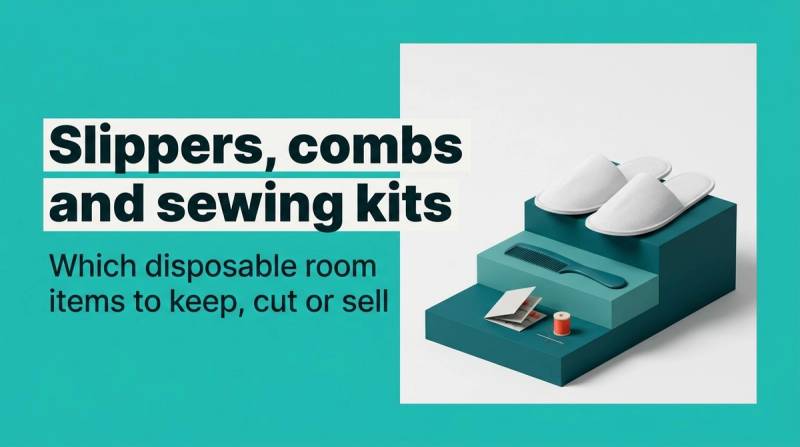
Slippers, combs and sewing kits: which disposable room items to keep, cut or sell
Decide which disposable room items to keep, cut or sell using three tests: unit cost, take rate and arrival-time need. This guide provides the audit, arithmetic and decision table for housekeeping and purchasing teams.
AI draft · awaiting editorial review
Contents
Key takeaways
- A disposable room item is judged by three numbers: its unit cost, its take rate, and the cost per occupied room it produces.
- Keep in the room only what a guest needs before they can reach the desk; everything else can arrive on request within minutes.
- Selling an item works only while the free basic option stays; without it the sale reads as a cut.
- A request item still has to reach the room at two in the morning, or it is not a policy, it is a shortage.
- Review after two months on the same items over the same period, and revert anything that raised complaints without lowering cost.
Disposable room items are the single-use things placed in a room and replaced at every departure: slippers, comb, sewing kit, shower cap, vanity kit. Decide each one with three tests, cost per occupied room, take rate and arrival-time need: keep what a guest needs immediately, give the rest on request, and sell only where a free option stays.
The storeroom holds four boxes of sewing kits nobody has opened in a year, and purchasing has been asked to cut the amenities budget. Both facts belong to the same decision, and the trolley is where it gets made. This article gives you the audit, the arithmetic and the decision table for hotel disposable room items, plus the guest message and the two-month review that keeps the decision honest.
What counts as a disposable room item, and why does the list keep growing?
A disposable room item is anything placed in the room for one stay and replaced when the guest leaves: slippers, a comb, a sewing kit, a shower cap, a vanity kit. The list grows because each item was added after a single complaint, and nothing is ever taken off.
Before deciding anything, sort the trolley into three kinds. Consumables are used up by the guest: soap, coffee, water. Single-use durables are taken or binned but not used up: comb, sewing kit, shower cap, slippers. Loan items must come back: iron, adapter, hair dryer. The three are managed with different numbers, and mixing them is the most common reason an amenities review fails.
Write the current list down from the trolley and the storeroom, not from the supplier catalog. The two rarely match, and the gap is usually the items nobody uses. For each item, record who added it, when, and which complaint it answered; an item with no answer behind it is a candidate for the request list. Separate "placed in every room" from "available at the desk": the difference is the take rate, not the unit price.
Note the guest segment. A resort with pool and spa carries different expectations from a city hotel selling to business travelers, and copying a competitor's room does not transfer its guest mix. Count what leaves the storeroom, not what arrives on the invoice; the two diverge as soon as occupancy moves. The full method for choosing the amenities list, setting par stock and controlling waste starts from the same count.
The trolley audit
ChecklistRun this in an afternoon, on one page
- List every item on the trolley, in the room and in the storeroom, in three columns
- Write the unit cost from the last invoice beside each
- Mark who signed off the last change to that item, and when
- Mark whether the item is placed, on request, or available at the desk today
- Circle every item in the storeroom but not in the room
- Circle every item with no complaint behind it
Consumable, single-use or loan
Single-use durables are the subject of this article. Loan items, like adapters and irons, follow a different logic entirely: they are tracked, logged and recovered, and the desk log that gets them back is a separate control from anything discussed here.
How do you work out the cost per occupied room for each item?
Divide what the item actually cost in a month by the rooms occupied in that month, and do it per item. A single amenities total hides the one line that is out of control.
Two numbers per item do the work. The unit cost comes from the invoice. The take rate is the units issued from the storeroom divided by rooms occupied in the same period. Count issues, not purchases: stock bought in March may be used in July, and a purchasing-based figure will show a saving that never reached a room.
Items left behind at departure still cost money. Housekeeping replaces them whether or not the guest used them, so the cost per occupied room includes the pairs and kits that went to waste.
TipThe formula
Cost per occupied room for one item = (units issued from the storeroom in the month × unit cost) ÷ rooms occupied in the month. Take rate = units issued ÷ rooms occupied. Run both for every item on the list, in the same month, before changing anything.
For example, illustrative only: with 1,000 occupied rooms in a month and 1,200 pairs of slippers issued at 9 lira a pair, the line costs 10.8 lira per occupied room. If 700 pairs left with guests and 500 were binned unused, the cost per pair actually used is a different number from the cost per pair placed, and both are worth knowing.
Compare items on the same basis and in the same month. A change in occupancy mix moves every line at once, so a month-on-month total can fall while a single item doubles. Give the number one owner: housekeeping issues it, purchasing prices it, the rooms manager answers for the total.
Why the monthly invoice misleads
The invoice records what was bought, not what was placed or used. A bulk buy in one month makes the line look like a spike, then a saving, with nothing changing in any room. The storeroom issue count is the figure that tracks what actually happened.
Which items should stay in the room, move to request, or be sold?
Keep what a guest needs in the first ten minutes and cannot reasonably ask for, move to request what a minority uses and housekeeping can deliver in minutes, and sell what a guest would choose and pay for while the free basic option stays.
Four tests do most of the work. Does the guest need it before they can reach a phone? Yes means keep. Is it used by most guests or by a few? Few means request. Can it reach the room within the time a guest will wait? No means keep. Does the guest compare it to a paid upgrade? Yes means it can be sold.
Slippers stay in resort and spa properties, where the guest walks from pool to room. A city hotel can keep one wrapped pair as the free option and sell the better one. The sewing kit moves to request almost everywhere: it is opened rarely, and when it is opened the guest needs one needle and a length of thread, not a folded box with six colors. The comb moves to request in most hotels and stays in properties whose guests arrive from long-haul flights without their own luggage.
Shower cap and vanity kit follow the segment: keep them where the guest profile expects a full bathroom line, move them to request where the bathroom already carries pump dispensers. Sell only alongside a free basic option, a thicker slipper, a fabric pouch, a laundry bag. Remove the free option and the same sale reads as a cut, and the complaint costs more than the item.
Whatever moves must still be obtainable at two in the morning without a purchase, from a stocked cupboard the night shift can reach.
| Item | Keep in the room | On request | Sell |
|---|---|---|---|
| Slippers | Resort and spa | City hotels | Thicker sole, beside a free pair |
| Comb | Long-haul arrival properties | Most hotels | Not sold |
| Sewing kit | Nowhere, usually | Almost everywhere | Not sold |
| Shower cap | Full bathroom line | Pump-dispenser bathrooms | Not sold |
| Vanity and dental kit | Where segment expects it | Elsewhere | Upgraded version only |
| Shoe sponge or shine | Business-heavy mix | Leisure mix | Branded version |
What decides each row: pool-to-room walking for slippers, whether guests arrive with their own luggage for the comb, how rarely the sewing kit is opened, the bathroom line already in place for the shower cap, guest profile for the vanity kit, and the business versus leisure mix for the shoe sponge. Loan items such as irons and adapters sit outside this table entirely; they are covered by the items the hotel lends and the log that gets them back.
What can be sold without a complaint
The sale reads as service only when the free option sits beside it and the price is visible at the point of offer, before the guest takes the item. The moment the free option disappears, the same shelf becomes a paywall, and guests price the complaint higher than the hotel prices the item.
How do you tell guests that an item is now on request?
Tell them before arrival and again in the room, name the item, name the channel to ask through, and give the time it takes to arrive.
Use three places: the pre-arrival message, a small card or sticker where the item used to sit, and the answer the desk gives. One of the three alone will be missed. Word it as a service, not a withdrawal: name the items, the channel and the delivery time in one sentence. "On request only" reads as removed and invites the complaint you were trying to avoid.
Write the card in the languages the hotel actually serves. A single-language card in an international property produces a complaint about the card, not about the item. Give the desk and the night shift the same script and a stocked cupboard; a request that turns into a search through the back office is the failure mode, not the request itself.
TipAn example room card
"Slippers, a comb and a sewing kit are brought to your room within 15 minutes. Call reception or scan the code below." Two rules stand behind it: name the items, the channel and the time; never write "on request only".
If the hotel runs a guest app, the request should land there and reach housekeeping as a task rather than a phone call someone has to remember. A guest app the hotel installs from the browser (the app: built, ahead of launch) is one way this works, and the same task flow belongs to the wider set of tools described on the platform overview (the system: built, ahead of launch). Log requests per item for two months: that count is the evidence for the next decision, and it shows whether the change was understood.
Slippers: which type, size and hygiene rule?
Choose slippers by sole, material and size range, wrap each pair, and never re-issue a pair a guest has worn.
The sole decides the use. A thin terry slipper suits a carpeted room; a thicker EVA or rubber sole suits pool decks, spa corridors and stone floors, where a thin sole is a slip risk. Open toe or closed toe follows climate and season: a closed toe reads warmer in winter and in cold-climate source markets.
Offer at least two sizes, or a printed range on the wrapper. One size fits few guests, and an ill-fitting pair is remembered longer than a missing one. Wrap or band each pair: the wrapper signals single use to the guest and tells housekeeping at a glance that the pair is untouched.
Placement follows the segment: bedside or wardrobe in resort properties, request in city hotels where the guest keeps shoes on. The cost driver is sole thickness and packaging, not the print on the fabric; cheaper print on a thicker sole costs more, not less. Store away from damp, because paper and foam take moisture from a bathroom wall.
Watch outA worn pair is waste, never stock
A slipper that has been worn does not return to the storeroom, is not re-bagged, and is not offered to a second guest, whatever its condition. The same rule covers any item that touches a guest's skin or feet.
How do you review the change after two months?
Compare the same three numbers for the same items over the same period: cost per occupied room, take rate, and the complaints that name the item.
Fix the baseline before the change: one month of issues and cost per item, written down and dated. Without it, the review becomes an argument about memory. Put the review date in the calendar when the change is made, with the rooms manager, housekeeping and purchasing in the room.
Read complaints by item, not by total. A falling cost with rising item complaints is a loss that has not reached the review score yet. Apply a revert rule in advance: an item that produces repeated complaints while saving little goes back into the room, and nobody has to defend the decision afterwards.
Handle leftover stock deliberately. Use it for requests until it runs out; do not return it to the rooms to "use it up", which restores the old habit and confuses the count. Re-check at the season change: the guest mix moves, the take rate moves with it, and a decision that held in August may not hold in February.
The two-month review checklist
Checklist
- Baseline cost per occupied room per item, dated
- Current cost per occupied room per item, same month before the change
- Take rate per item before and after
- Complaints naming each item, counted separately
- Request log per item, counted
- Decision per item: keep the change, revert, or sell
- Leftover stock plan
- Next review date
What to do next
Walk the trolley and the storeroom this week, price every item on it, and run the four tests once per item. The keep, request and sell columns then fill themselves, and the two-month review has a baseline to measure against. The pieces fit in one order: know the list, know the cost per occupied room, decide per item, tell the guest properly, and check the result on the same numbers you started with.
If you manage housekeeping or purchasing, the next step is to pick two or three of these items and test them on a single floor for a month, with the cost and the guest requests written down. To review what those changes do to revenue and to the guest's bill, talk to OtelCiro (opens in a new tab).
Frequently asked questions
Are hotel slippers reusable?
Treat a room slipper as single use: it is placed for one stay, wrapped, and replaced at departure. A worn pair is waste and never returns to the storeroom. Reusable slippers exist for spa and pool use, but they are a different item with a different washing cycle and should not be mixed with the room pair.
Should we charge guests for slippers or a sewing kit?
Charging works only where a free basic option remains and the price is visible at the point of offer, before the guest takes the item. An accepted charge goes onto the guest's bill like any other hotel charge. Whether a charge suits the segment is a commercial decision, and how it is documented is a question for the hotel's accountant.
How many spare items should housekeeping carry on the trolley?
Set the trolley stock from the rooms one trolley services in a shift, plus a small margin, and refill from the storeroom at the end of the shift rather than during it. The par stock for the storeroom is a separate number and belongs to the same review as the cost per occupied room.
What do we do with leftover stock after moving an item to request?
Keep it and issue it against requests until it runs out. Do not return it to the rooms to use it up, because that restores the old placement and muddies the request count. Record the run-down date so purchasing does not reorder on the old pattern.
Will guests complain when an item moves to request?
Some will, and the message and the delivery time decide how many. Name the item, the channel and the time it takes, keep the night shift stocked, and count the requests per item. If complaints name the item repeatedly while the saving is small, put it back in the room.