A guest asks to stay longer and the room is sold: the options, the wording and the record
An extension is a new sale, not a favor. Learn the three checks to run before answering, the five options to offer, and the record to complete before the guest leaves the desk.
AI draft · awaiting editorial review

Contents
Key takeaways
- The room, not the room type, decides the answer: check what is assigned to that specific room tomorrow before saying anything to the guest.
- An extension is a new sale, so the price is quoted before it is confirmed, in writing, by one person the guest can name.
- A room move is a timetable, not an apology: block the new room, agree the window, carry the bags, keep one folio.
- Nothing is agreed at the desk until the departure date, the keys, the folio and the guest identity notification (KBS) entry are updated.
- Say no once, give one reason, then offer two concrete alternatives; repeating the refusal is what the guest remembers.
An extension is a new night sold on availability, so check three things first: what is assigned to that specific room tomorrow, what the extra night costs on which rate, and whether the original channel has a say. Then offer one of five answers: same room, another room, another hotel, a split stay, or a clear no with alternatives.
It is late evening and the guest at the desk wants one more night. The room is already assigned to an arrival tomorrow, and the original booking came through an agency that knows nothing about this conversation. This is the moment when a hotel guest asks to extend a stay and the room is sold, and what happens next decides whether the hotel gains a sale or a complaint. After reading this you will know the three checks to run before answering, the five options to offer, the wording for each, and the record to complete before the guest leaves the desk.
What should the front desk check before answering an extension request?
Three checks decide the answer: what is assigned to this specific room tomorrow, what the extra night would cost on which rate, and whether the channel that sold the original booking has a say.
Check the room, not the room type. A free room of the same category elsewhere in the building turns a no into a room move; a free room on the availability screen tells you nothing about this guest's room. Read tomorrow's arrivals, not just the count: how many, at what hour they are expected, and which of them are repeat guests or long stays that must not be moved.
Identify the rate the extra night would carry before you speak: the rate of the original booking, the rate of the day, or a stated extension rate. Check the channel too. If a travel agency or an online travel agency (OTA) sold the original booking, the extra night may sit outside that contract, which usually makes it a direct sale with its own price.
Ask what the guest actually needs: a bed until tomorrow, or the room until the evening today. A late checkout can answer the second question for less money and no inventory, and it has its own policy and its own way of being answered (see late checkout policy and how to answer the request). If the request runs a week or more, stop treating it as an extension and involve a manager: a long stay needs a plan for housekeeping, billing and service, not a nightly decision.
ChecklistBefore any answer is given, complete these six checks
- The next booking assigned to this exact room
- Tomorrow's arrival list with expected times
- The rate that would apply to the extra night
- The channel that sold the original booking, and whether it covers the extra night
- What the guest needs the room for, and until when
- Whether the request is long enough to need a manager
What are the options when the room is sold?
There are five honest answers, and only one of them is no: keep the same room if it is free, move the guest to another room, place the night in another hotel, split the stay, or decline with alternatives.
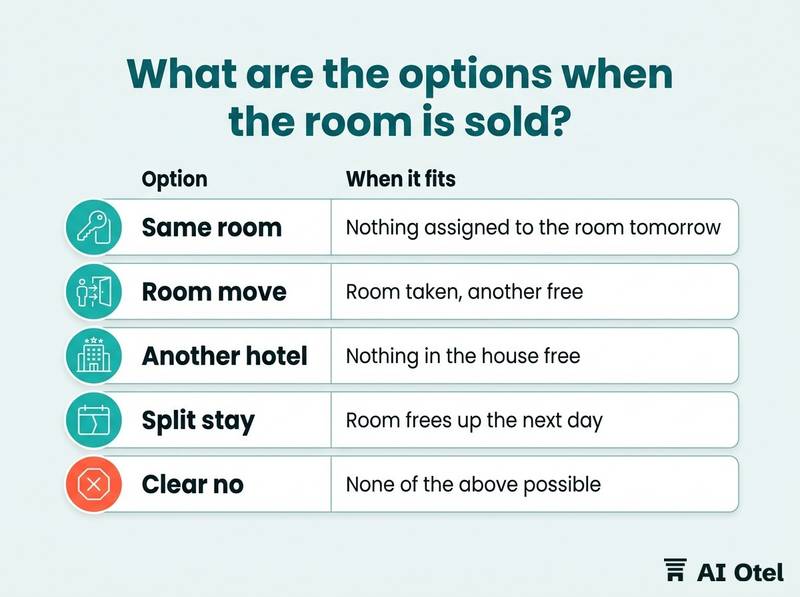
Same room works only when nothing is assigned to it tomorrow; extend the reservation in the system, never in a note. A room move keeps the hotel and changes the room, usually for one night or the rest of the stay. Another hotel means the desk finds and holds the night elsewhere, and says plainly that it is a different property with a different standard and price. A split stay gives the guest one night away and then a return to the original room, which works when the room frees up the next day and the guest would rather not change hotels twice.
A clear no is also an answer: say it once, give one reason, then offer what you can still do, such as holding the luggage, a late checkout, or a booking for the next visit. There is a smaller sixth answer too: a late checkout or a day-use room when the guest only needs the room until the evening.
| Option | When it fits | What the guest notices | What the desk must do |
|---|---|---|---|
| Same room | Nothing assigned to the room tomorrow | Nothing | Extend the reservation, reissue keys |
| Room move | Room taken, another free | Packing, a new room | Block the room, agree a window, carry bags, keep one folio |
| Another hotel | Nothing in the house free | A different property and price | Find and hold the night, state the difference |
| Split stay | Room frees up the next day | One night away, then a return | Book both parts, keep the folio and record straight |
| Clear no | None of the above possible | An honest answer and an alternative | Say it once, offer two concrete options |
Placing a guest in another hotel because a room is sold is not the same job as walking a guest out of an overbooking, which has its own procedure and its own rules (see how walking a guest works when the hotel is overbooked). And a guest who ends up staying for weeks needs a different kind of plan altogether, which is described in a service plan for guests staying from the second week on.
How do you move a guest to another room without spoiling the stay?
A room move is a timetable: block the new room first, agree a window with the guest, carry the bags with staff, swap the keys, and keep one bill.
Block the new room in the system before you promise it. A room that is only probably free is how one move becomes two problems. Agree the window, usually late morning once the new room has been cleaned, and give the guest an exact time rather than sometime after check-out.
Say who carries the bags. Staff carry them; the guest packs, or staff pack with explicit permission and a written list of what was moved. Prepare the new keys in advance and hand them over in one step, so the guest does not queue at the desk twice.
Keep one folio. Transfer the charges to the new room number instead of opening a second bill, and check that restaurant and minibar charges follow the guest. Tell housekeeping, the breakfast list and the phone operator: a moved guest who is called in the old room has been failed twice.
If the new room is a different category or price, say so and agree the price before the move, not at checkout. Update the room number in the guest identity notification (KBS, the misafir kimlik bildirimi required of lodging facilities in Türkiye) record if it carries one, and in the reservation notes.
Watch outTwo promises not to make
Never promise a room you have not blocked in the system, and never move a guest into a room that housekeeping has not released.
What does the extra night cost, and who tells the guest?
The extension night is a new sale at a rate the hotel can defend, quoted before anything is confirmed, by one person the guest can identify.
Choose between three candidate rates: the rate of the original booking, the rate of the day, or a stated extension rate. Pick the policy in advance and write it into the front-office manual so two staff do not quote two prices. Quote per night, with the total including breakfast and taxes, and say what is included and what is not.
Put it in writing: a short message to the guest's phone or a printed note with the dates and the price, so the checkout conversation is a reminder rather than a dispute. If the original booking came through an agency or an OTA, the extra night often falls outside that contract; treat it as a direct sale and say so plainly. Name the person who quoted it, so the guest knows who to ask for if the bill differs.
Never let the guest discover the extension price at checkout. A price heard for the first time on departure is a complaint, whatever the number. If the guest asks for a discount, the answer is a decision with an authority level, not an improvisation at the desk. How the rate, the fee and the channel interact when dates change is worth a policy of its own, covered in rate, fee and channel when the stay dates change.
Key pointOne rule
The extension price is quoted, accepted and written down before the departure date is changed.
What do you say when the answer is yes, when it is a move, and when it is no?
Say the answer, one line of reason, and the next step, in that order, and never blame the system.
Saying yes
Confirm the night, the room, the price, and whether the keys keep working or will be reissued. For example: "Yes, we can keep you in 304 tomorrow as well. The night is 90 euro with breakfast, tax included. Your key card will keep working, no need to come back to the desk."
Saying the guest will move
Name the new room and the time, say who carries the bags, and confirm whether the price stays the same or changes. For example: "We can keep you with us, but in room 512 from 12:00 tomorrow. Our colleague will move your bags, and the price stays the same."
Saying no
Say it once, give one reason, then move immediately to two alternatives. For example: "We are full tomorrow because of a group arrival. What I can do is hold your luggage and call the hotel across the park, or book you back here from the day after."
Avoid "the system won't let me" and a bare "we are fully booked". Both sound as if no one at the hotel is in charge. Write the three scripts in the hotel's own words and keep them in the front-office manual, in the languages the desk actually covers, so the night shift gives the same answer as the morning shift. If the guest is upset, stop explaining and start solving: a held bag, a late checkout, a call to a nearby hotel, a note for the next stay.
NoteThe shape of every answer
Answer, one reason, next step. The guest hears the answer first and the reason second; a reason without an answer sounds like an excuse.
What must be written down before the guest leaves the desk?
One minute of writing prevents the three classic failures: housekeeping cleaning an occupied room, a price dispute at checkout, and a stay record that no longer matches the guest's dates.
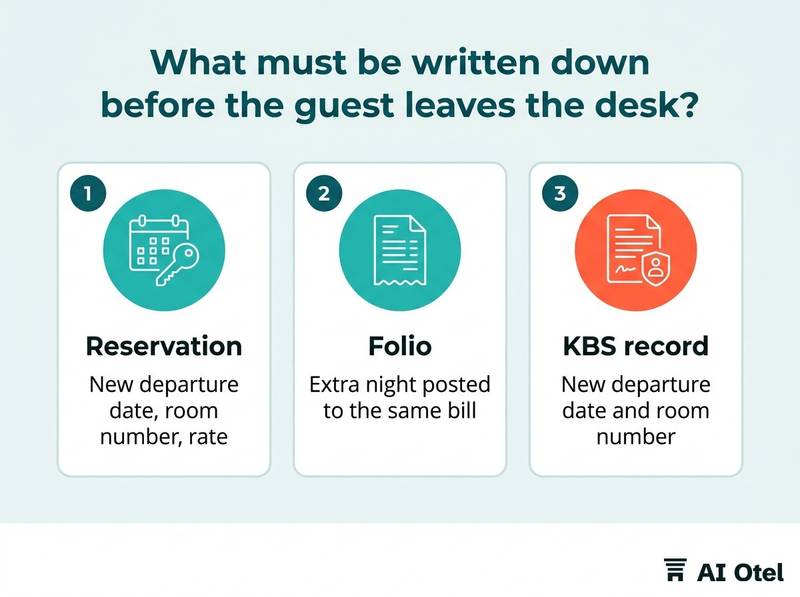
The reservation needs the new departure date, the room number, the rate, and the name of the person who approved it. The folio needs the extra night posted to the same bill, or a written note saying how and when it will be settled. Where the KBS record carries the room and the dates, update it with the new departure date and room number, and keep the note factual and short.
Housekeeping and the breakfast list must be informed, so the room is not cleaned as a departure and the guest is not dropped from the list. The notes field should carry the date, the time, who spoke to the guest, what was agreed, what was refused, and what the guest was told about the price. A short confirmation to the guest repeats the dates and the price, so both sides hold the same version of the agreement.
ChecklistSix items to complete before the guest leaves the desk
- Departure date changed in the reservation
- Room and rate recorded
- Folio updated, or a settlement note written
- KBS entry updated
- Housekeeping and breakfast list informed
- Guest confirmation sent, and a handover note left for the next shift
The one-page extension routine
The next step is a one-page extension routine kept at the desk: the three checks, the five options, the three scripts and the six record items, used by every shift. The parts fit in one order: check, choose, price, say, record. In that order, an extension stops being an argument and becomes a sale.
Frequently asked questions
Can the front desk simply refuse to extend a stay?
A booking covers the nights it names; any further night is a new sale decided by availability, so the desk can say no. The answer must still be given properly: once, with one reason, followed by two concrete alternatives. Whether a confirmed extension can later be shortened, or a guest asked to leave, is a contract question for the manager and, where it matters, the hotel's legal adviser.
Should the extra night cost the same as the original booking?
That is a hotel policy, not a rule: the candidates are the original booking rate, the rate of the day, or a stated extension rate. The policy must be written down before the situation arrives, so two staff do not quote two prices. When an agency or an OTA sold the original booking, the extra night often sits outside that contract and is sold directly, at a price quoted before confirmation.
Does the guest have to come to the desk to extend?
No. The request can arrive by phone or from the room, and the decision is the same three checks. What cannot be skipped is the record: the departure date, the keys, the folio and the KBS entry are updated the moment the extension is agreed, not at the end of the shift. Identity is checked in person when the guest checks in; an extension updates the record rather than repeating the check-in.
What if the guest only needs the room until the evening?
Then the question is a late checkout or a day-use room, not an extra night, and it should be answered before anyone touches tomorrow's inventory. It is cheaper for the guest and keeps the room sellable. The hotel needs a written policy on how late is possible and what it costs, so the answer does not depend on who is on shift.