Front desk role-play: five complaint scenes to practice in a ten-minute team briefing
Rehearse the first thirty seconds of a complaint with five ready scenes and a four-point scoring card. Each ten-minute briefing ends with one agreed change written on the shift board.
AI draft · awaiting editorial review
Contents
Key takeaways
- A ten-minute briefing trains the first thirty seconds of a complaint, which is where the guest decides whether to escalate.
- Three roles and a timer are enough: a guest, an agent, and an observer holding a four-point card.
- Every scene needs a hidden twist, because a scene without one teaches a script instead of judgment.
- Score the four moves (listen, apologize, act, record), not the guest's mood; a scene can pass while the guest stays angry.
- Each session ends with one agreed change, written where the next shift actually looks.
Role-play is a rehearsal, not a lesson: three people, one scene, ninety seconds of play and two minutes of feedback. Five scenes (room not ready, noise, a billing dispute, wrong room type, a lost key card) rotate through a month of ten-minute briefings, each ending with one agreed change written on the shift board.
The guest is at the counter, the room is not ready, and the agent has about eight seconds to say something. That moment is what the briefing should rehearse, and it takes ten minutes, not a training day. This article gives you the format, five ready scenes with their twists, a four-point scoring card and a feedback loop that fits inside a shift handover. The same routine is part of a wider hotel guest complaints at the front desk: a recovery routine.
Why does ten minutes of role-play beat an hour of lecture?
Because the skill being trained is a short sequence of moves under mild pressure, not a body of knowledge. Saying the words out loud once is worth more than hearing about them for an hour.
A complaint is decided early. The guest is reading whether the person in front of them has understood, not whether the hotel has a policy. A lecture transfers categories such as service recovery; a rehearsal transfers the actual first sentence, which is the only part the guest hears clearly.
Ten minutes also fits inside a shift handover, so front desk role play training can happen every week. A half-day course can happen only once a season, and the skill decays in between.
Role-play rehearses delivery, not policy. Refund limits, deposit rules and who may move a guest are written rules the front office manager owns; the scene only practices saying them. Keep the stakes low: no prizes, no ranking, and the manager does not play the angry guest in the early rounds. The output is a sentence, not a feeling: one agreed wording or one agreed step, written down before the team leaves the counter.
Key pointScore the doing, not the mood
The scene is scored on what the agent did, never on whether the guest calmed down. A calm guest can hide a missed step, and an angry guest can hide a good one.
How do you set up a role-play in ten minutes?
Three roles, one scene and a timer: a guest, an agent and an observer with the card. Ninety seconds of play and two minutes of feedback is the whole format.
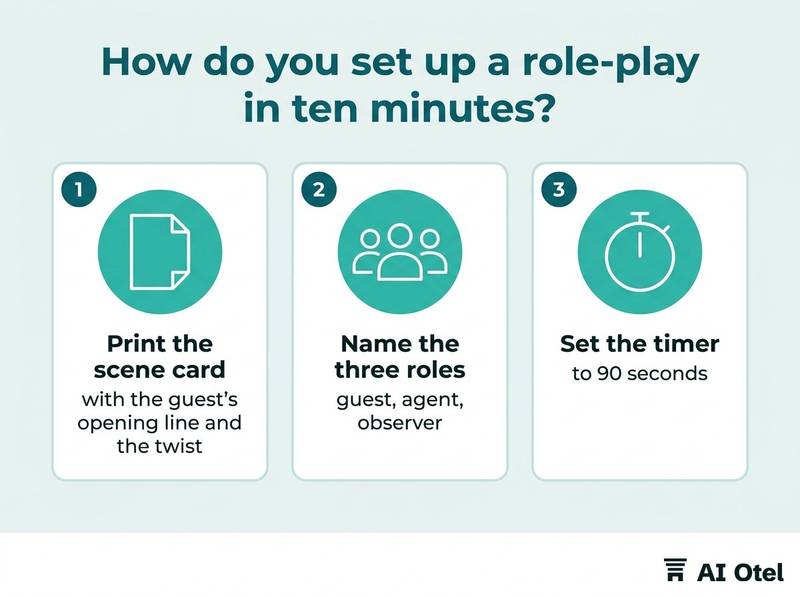
The guest plays the complaint and holds the hidden twist. The agent is the person being trained. The observer fills the card and says nothing while the scene runs.
The manager stays out of the guest role at first: people perform for the boss instead of practicing, and the feedback then comes from the wrong person. Ninety seconds is enough, because a real complaint is settled or escalated in the first half minute, so the scene should reach the decision point and stop there.
Stand at the real counter with the real telephone and terminal. The furniture and the screen are part of the habit being built. Brief the guest privately and in writing, thirty seconds before the scene, so the twist arrives as a genuine surprise. If only two people are on shift, the guest gives the feedback afterwards and the card is filled from memory.
ChecklistSetup checklist
- Print the scene card with the guest's opening line and the twist
- Name the three roles: guest, agent, observer
- Set the timer to 90 seconds
- Move to the actual counter
- Brief the guest privately, in writing
- Keep the manager out of the guest role
- Observer writes and does not speak during the scene
What are the five scenes, and what is the twist in each?
Five scenes cover most of what a desk actually receives: a room not ready, noise, a billing dispute, a wrong room type and a lost key card. Each carries a hidden twist that removes the easy answer.
The twist is the whole exercise. Without it the agent rehearses a script, and the script fails the first time the facts differ. In the room-not-ready scene, the room is clean but held for a group arriving tonight, so the easy offer of another room spends inventory the hotel needs. In the noise scene, the source is the street or the hotel's own machinery, so "we will speak to the neighbor" is a promise the desk cannot keep.
The billing dispute is the sharpest: the charge is real in the system, the signature slip is missing, and the guest changed rooms mid-stay, which is where folio errors usually start. If your team needs the background, see how a hotel counts nights and days. The wrong-room-type scene has the guest right and the system right at the same time: the reservation is correct and the room was reassigned when another guest overstayed. In the lost key card scene, the reservation sits in a colleague's name, so the screen proves nothing about who is standing there; identity is checked in person at the desk before a new card is cut.
| Scene | What the guest says | The hidden twist | The one change to agree |
|---|---|---|---|
| Room not ready | "I booked an early check-in and the room still is not ready" | The room is held for a group arriving tonight | Who may release a held room, and what the desk may offer alone |
| Noise | "The room next door kept me awake until three" | The source is the street or the hotel's own machinery | The sentence that names the real source, and what can be done tonight |
| Billing dispute | "I never touched the minibar" | The charge is in the system, the slip is missing, the guest changed rooms mid-stay | What may be voided on the spot, and who reviews it in the morning |
| Wrong room type | "I paid for a sea view" | The reservation is correct; the room was reassigned during an overstay | The compensation menu, and who authorizes each item |
| Lost key card | "I lost my card and my passport is in the room" | The reservation is in a colleague's name | The identification step at the desk before any new card is cut |
What goes on the four-point card?
Four moves: listen, apologize, act, record. The card measures what the agent controlled, which is why a scene can pass while the guest stays angry.
Listen means the guest finishes without interruption, and the agent repeats the complaint back in one sentence before answering. Apologize means naming the experience ("I am sorry you did not sleep"), not a fault the hotel has not established, and never a conditional apology such as "if you feel that way". Act means one concrete action with a time attached, inside the agent's authority; if it needs a manager, the agent names the person and the time. Record means room number, time, what was promised and by whom, written where the next shift actually looks.
Score the four moves separately so feedback can be specific. "Good attitude" cannot be coached; "you answered the telephone mid-complaint" can. Use the same card every week, so the team sees a stable standard rather than the manager's mood on the day. For the words themselves, keep a card of front desk phrases in English, German and Russian at the counter.
| Point | A pass looks like | The usual failure |
|---|---|---|
| Listen | The guest finishes and the agent repeats the complaint in one sentence | The agent explains policy while the guest is still talking |
| Apologize | The experience is named without admitting a fault nobody has checked | "If you feel that way", or an apology for the hotel's "terrible service" |
| Act | One action with a time, inside the agent's authority | "I will see what I can do", with no name and no time |
| Record | Room, time, promise and owner written where the next shift reads it | The promise lives in the agent's memory and leaves with the shift |
How do you give feedback in two minutes?
The agent speaks first, the guest speaks second, the observer gives one thing that worked and one to change, and the agreed change is written down. Two minutes, four steps.
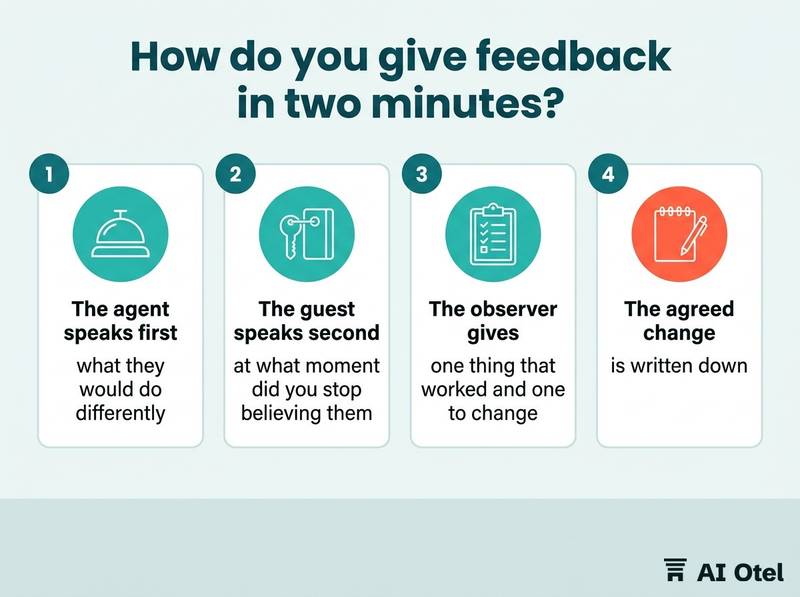
Ask the agent what they would do differently in the first ten seconds. Self-assessment lands before anyone else's opinion. Then ask the person who played the guest one question: at what moment did you stop believing them? That answer is worth more than a list of remarks.
One change only. Two changes in one round means the agent remembers neither. Describe behavior, not character: "you picked up the telephone mid-sentence" rather than "you were distracted". Do not demonstrate in front of the team unless the agent asks; a manager's polished performance teaches the team that the standard is unreachable.
Replay the same scene next week with the agreed change. That is the only evidence the briefing changed anything. If these observations will feed a formal review, say so before the session starts, and see the hotel staff performance review form for how scoring and reviewers should be decided in advance.
TipThe two-minute loop
30 seconds for the agent's own review, 30 for the guest's one answer, 30 for the observer's one thing that worked and one to change, 30 to write the agreed change on the card and on the shift board.
How do you keep the scenes fresh month after month?
Keep five scenes live, retire one a month, and replace it with a scene written from a real complaint logged in the last thirty days.
Source the new scene from the complaint log or the night report, then strip names, room numbers and anything that could identify a guest before it becomes a script. Keep the twist when you rewrite: a replacement scene without one teaches a script, and the team will notice within a week.
Rotate roles. The strongest agent should play the guest at least once a month, because playing the guest teaches more than playing the agent. Run the five scenes inside a new colleague's first week, next to the department checklist, so the first real shift is not the first rehearsal.
Watch for repetition. If the same failure appears in three sessions, it is a rule problem rather than a training problem, and it belongs on the front office manager's desk. Keep one page per scene so a supervisor can run the briefing when the manager is off.
ChecklistMonthly maintenance checklist
- Five scenes live at all times
- Retire one scene
- Write the replacement from a real logged complaint, with identifying details removed
- Keep the twist
- Rotate the guest role
- Run the set in a new colleague's first week
- Escalate any failure that repeats three times as a rule change
- Keep one written page per scene
What to do next
Pick one scene, run it at the next handover, and write the single agreed change on the shift board before the team disperses. The five scenes, the four-point card and the two-minute feedback loop only work as a weekly habit: each session adds one sentence to the hotel's written practice, and the next shift inherits it.
Frequently asked questions
How long should a front desk role-play session last?
Ten minutes in total: about ninety seconds of play, two minutes of feedback, and the rest for setup and writing the agreed change. Run one scene per briefing and cycle the five scenes across a month, so nobody has to find a training day.
Who should play the complaining guest?
Rotate the role, and keep the manager out of it in the early rounds so the team practices rather than performs. Brief the guest privately and in writing so the twist is a surprise, and let the strongest agent take the guest role regularly, because it teaches the most.
Should role-play scores go into performance reviews?
Decide before the first session and tell the team which it is. Coaching notes stay coaching notes; if the observations will feed a formal review, use the same four points every time and say who sees the card.
What if a team member refuses to act it out?
Start them as the observer, then as the guest, then as the agent, and allow the opening lines to be read from the card. Keep it voluntary in the first weeks: the goal is that the words come out under mild pressure, not that anyone performs.
Can two people on shift run this?
Yes. One plays the guest, one plays the agent, and the feedback happens straight afterwards with the four-point card filled from memory. An angry or threatening guest is a different exercise with a different setup and should not be improvised inside a ten-minute briefing.