Guest names in other alphabets: a spelling routine for Arabic, Cyrillic and Persian names
One guest name often arrives in three spellings. This guide shows how to pick the passport Latin line as the record of truth, store variants, and correct names without losing the booking trail.
AI draft · awaiting editorial review

Contents
Key takeaways
- A guest name is not one fact: the booking, the passport and the bill each hold their own version, so the desk has to decide which one the hotel treats as the record of truth.
- The Latin line printed on a passport is the steadiest single source for spelling, because it is fixed when the document is issued and does not change between stays.
- Arabic, Cyrillic and Persian names each contain a small set of letters that produce several accepted Latin forms; the hotel's job is one agreed form, written the same way everywhere.
- A name correction changes a record, so it needs a named person, a time and a note, never a silent retype.
- Ask the guest once, at arrival, how they want their name written, and store the answer where the next shift will find it.
Guest name transliteration at a hotel desk means writing a name from one alphabet into another. One guest name can be spelled three ways because the booking, the passport and the bill are produced by different systems. Pick one record of truth, usually the passport's Latin line, copy it exactly, and correct every other field to match it.
A guest books a room as Mohammed Al-Rashid, hands over a passport written in Arabic script, and asks for the bill in a company name. The desk now holds three versions of one person and has a minute to decide which one the hotel will treat as the record. After reading this article you will have that decision made in advance: which field is the record of truth, how to read an Arabic, Cyrillic or Persian passport line, which spelling goes on the key card and the bill, and how to correct a name without losing the booking trail. If you collect the name before arrival, asking guests to type their own name before arrival removes one of the three versions at the source.
Why does one guest name arrive in three spellings?
Because the three places a name lands are filled by three different people or systems, each working from a different source and a different alphabet.
The booking is typed by the guest, a travel agent or a channel, often quickly, in whatever Latin letters the person typing chose that day. The passport carries the name in its own script plus a Latin line fixed when the document was issued; that line does not change between stays. The bill is written for a different purpose and may follow a company or agency name rather than the traveler's own.
The hotel therefore needs one written rule: which field is the record of truth, and which fields copy from it. Without that rule the same guest appears twice in the history, preferences split across two profiles, and staff cannot find the earlier stay when the guest returns. A walk-in guest is the easy case, because the document is in front of you and the guest is at the desk; the hard case is a booking made months earlier by someone else, the situation covered in taking a walk-in guest with no booking to compare against.
Key pointRecord of truth
The one field the hotel treats as correct and the field every other copy is made from. Choose it once, write it into the front office manual, and never let a second version overwrite it without a note.
How do you read an Arabic name from a passport?
Read the passport's Latin line first, then use the Arabic line only to check what the Latin line has shortened, joined or dropped.
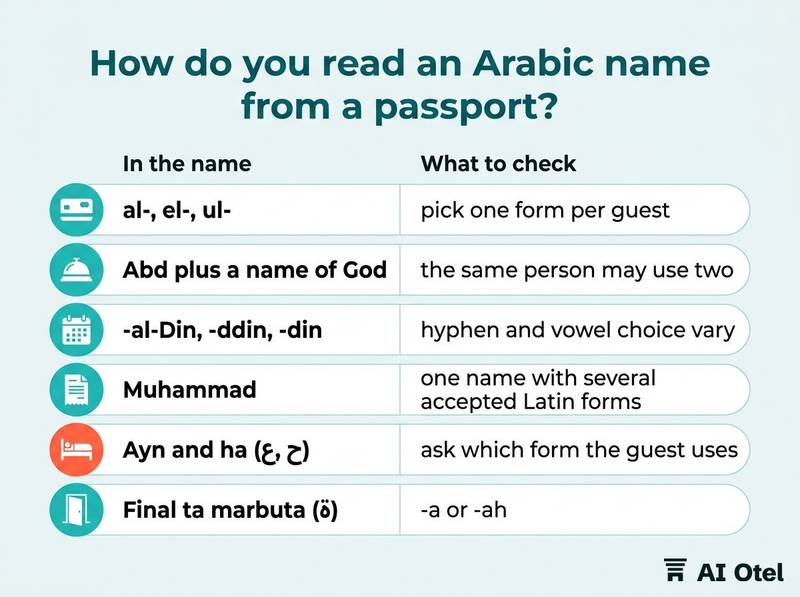
Name order runs given name, father's name, grandfather's name, family name; the family name is not always the last element on a Latin line, and some records put it first. The definite article appears as al-, el-, ul- or joined to the next word, so one family is Al-Rashid, Alrashid and El Rachid in three bookings.
Several letters have no single Latin equivalent, so the same letter becomes a, ah, q, k, kh or nothing at all depending on who typed it. Doubled letters and long vowels are where most variants appear: Muhammad, Mohammed, Mohamed and Muhammed are one name, not four guests. Do not improve a guest's own spelling toward a form that looks more familiar to you; the guest's form is the one that will match their bank card and their next booking.
| In the name | Common Latin forms | What to check |
|---|---|---|
| al-, el-, ul- (the definite article) | Al-Rashid, Alrashid, El Rachid | pick one form per guest and keep it in the profile |
| Abd plus a name of God | Abdullah, Abdallah, Abd Allah, Abdul Rahman | the same person may use two of these on two bookings |
| -al-Din, -ddin, -din | Nur al-Din, Nureddin, Nourredine | hyphen and vowel choice vary, so copy the passport |
| Muhammad | Muhammad, Mohammed, Mohamed, Muhammed | one name with several accepted Latin forms |
| Ayn and ha (ع, ح) | written as a, with a mark, or dropped | ask which form the guest uses |
| Final ta marbuta (ة) | -a or -ah | Fatma or Fatimah, Aisha or Aishah |
Cyrillic names: which Latin letters should the desk use?
Use the Latin line printed on the passport, and treat any other Latin version as a variant to be recorded, not as a mistake to be corrected.
Russian, Ukrainian, Bulgarian and Serbian passports print a Latin line under the Cyrillic one; that line is the version the document itself carries, so it wins over anything typed at booking. The pairs the desk meets most: ya or ia, yu or iu, yo or e, zh, kh, ts, ch, sh, shch, y, and i or y for the short i.
Surnames often arrive in a feminine and a masculine form; keep the form the passport shows rather than the one the booking used. Many Cyrillic passports print the surname first and the given name second; do not swap them when typing into a system that expects the given name first. The difference between e and yo, and between i and short i, changes both the pronunciation and the search result, so copy letter by letter.
Names of Tatar, Georgian or Greek origin written in Cyrillic often have a settled Latin form the guest uses every day; ask instead of rebuilding it.
ChecklistBuilding the Latin line from a Cyrillic passport
- Find the Latin line under the Cyrillic.
- Note which element is the surname and which is the given name.
- Copy letter by letter, including doubled letters.
- Compare with the booking and mark the differences.
- Write the variant you saw into the notes field.
- Read the name back to the guest before the key is cut.
Persian names: which letters change the spelling?
Persian uses the Arabic script with four extra letters and different habits for three common ones, so a name that looks Arabic can need a different Latin form.
Persian adds pe, che, zhe and gaf, letters that do not exist in Arabic; a name containing them has no Arabic spelling to copy from. The Persian kaf and ye are written differently from their Arabic counterparts but transliterate the same, as k and as i or y.
Vav is read as v or as u depending on the word, which is why the same name appears as Navid or Nouvid, Kourosh or Kurush; the guest's own Latin form settles it. A final he is usually written -eh or -e in Latin, and the linking vowel between two parts of a name is not written at all. Compound names such as Mohammad Reza, Seyyed Ali or Amir Hossein are sometimes hyphenated and sometimes run together; pick the guest's form and keep it.
Ask once at arrival and write the answer into the profile, or the same guest will arrive as a new person next season. If your guest mix includes Persian speakers, this routine belongs inside a language plan matched to your guest mix.
Watch outDo not arabize a Persian name
Do not convert a Persian name into its Arabic-looking form. The four Persian-only letters and the v or u reading of vav will change the name past recognition, and the guest will not find their own reservation.
Which spelling goes on the booking, the key card and the invoice?
The passport's Latin line is the record of truth for the guest record; the key card carries a working form of it, and the bill follows the details the payer gives.
The reservation and guest profile take the passport's Latin line copied exactly, with every other version stored as a known variant. The notes field is where variants live, so a later search for either spelling returns the same person instead of creating a second profile. The night audit reads the same field as the desk, so the field has to be agreed once rather than per shift.
| Where the name appears | Which version | Why |
|---|---|---|
| Reservation and guest profile | the passport's Latin line, copied exactly | it is the version the document fixes |
| Known variants | every other spelling seen, in the notes field | a later search finds the same person |
| Key card and welcome letter | the name the guest asks to be called by | it is a courtesy, not a record |
| Folio addressed to the guest | the profile name | the guest recognizes the bill |
| Invoice to a company or agency | the payer's billing details | the guest name stays on the folio as the stay record |
A folio addressed to the guest uses the profile name, so the guest recognizes the bill at check-out. A bill addressed to a company or an agency uses the payer's billing details, while the guest name stays on the folio as the record of the stay. How a name must read on a fiscal document is a question for your accountant. Because the key card carries the name, this routine also touches confirming who is asking before a key card is reissued.
How do you correct a guest name without losing the booking trail?
Correct the field in place, keep the booking reference and the original spelling in the notes, and record who changed it and when.
Name corrections belong to a supervisor or the duty manager, not to whoever is at the desk at three in the morning with a queue in front of them. The note holds four things: the old spelling, the new spelling, the document the desk actually saw, and the person and time of the change.
The booking reference, the rate, the dates and the payment record do not change; a name correction is not a rebooking. When the booking came through an agency or a channel, the name held on that side may be the one the guest is asked to quote, so tell the guest which version to use at the door.
A name change on an in-house booking is also a security question: confirm the room, the dates and one detail only the guest would know before a new key is cut. Never delete the original entry; the trail is what lets the next shift explain what happened without guessing.
What belongs on a one-page card at the desk?
Six lines: the record of truth, three reading rules, the correction rule and the read-back habit.
Line one names the record of truth and says that every other field copies it. Line two says read the Latin line first and the script line second. Line three says keep the guest's own form and never improve it. Line four says store variants in the notes field so the search still works. Line five says corrections go through a supervisor, with old form, new form, document, name and time. Line six says read the name back to the guest while they are still in front of you, and let them correct you.
ChecklistThe desk card, six lines
- Record of truth is the passport Latin line; everything copies it.
- Read the Latin line first, the script line second.
- Keep the guest's own form.
- Store variants in the notes field.
- Corrections by a supervisor, with old form, new form, document, name and time.
- Read the name back before the key is cut.
What to do next
Write the six-line card today, put it at the desk and test it on the next arrival: one source, three reading rules, one correction rule. The parts fit together as a single routine, so the booking, the key card and the bill stop describing three different people, and the next shift can see what was changed and why. If you are weighing software, check how candidates handle guest profiles and name variants: a hotel operating system should let you store the profile name, the variants and the notes in one place, and the wider platform overview shows how these records connect to reservations and billing.
Frequently asked questions
Should the name on a hotel booking match the passport exactly?
For the guest record, yes: copy the Latin line the passport carries. A booking made earlier may hold a variant, so correct the field, keep the old form in the notes, and leave the reference and dates alone. The name the guest is called by at the desk can be shorter, but it is not the record.
What is transliteration, in plain words?
Writing a name from one alphabet into another. Several accepted systems exist, so one name can have more than one correct Latin form. The hotel's aim is consistency across its own records, not a verdict on which form is right in the abstract.
Can reception simply ask a guest how to spell their name?
Yes, once, at arrival, and it is faster than guessing. Write the answer into the profile so the next stay starts from it. Asking also tells you which form the guest uses on their bank card and their own bookings.
What if the name is wrong on a booking that cannot be cancelled?
A name correction is not a cancellation: the reference, the dates and the rate stay as they are, and only the name field changes with a note. When the booking came through an agency or a channel, check with that side whether the rate is tied to the named traveler, and tell the guest which name to quote.
Should we keep the name in its original script as well as in Latin letters?
Keeping both helps staff recognize the guest and read the document at the next arrival, and it makes a match against the passport line quick. Whether your system has a field for the original script, and where it sits, depends on the system; the notes field is the fallback.