How a hotel counts nights and days: arrival after midnight, late check-out and a stay across a price change
A night belongs to the date it starts, not the clock time of arrival. This guide explains how to count nights, price late check-outs and split bills across rate changes.
AI draft · awaiting editorial review

Contents
Key takeaways
- A night belongs to the date it starts: a 02:00 arrival on 12 June occupies the night of 11 June, not the night of 12 June.
- The check-out day is a day but never a night, which is why three nights run across four calendar dates and bill three.
- Late check-out is a policy choice priced as extra hours, a half day or a full night, and the time boundary matters more than the amount.
- When a stay crosses a rate change, each night is priced at the rate attached to its own date, and the bill shows the split.
- Room nights in reports follow the same rule as the bill: one night, one date, nothing on the departure day.
A night is a room held overnight, counted by date and not by the clock. The arrival date owns the first night, each following date owns one more, and the check-out day is a day but not a night. A 02:00 arrival takes the previous date's night; a stay across a rate change is priced night by night.
A guest books one night, lands at 02:00, and the desk tells them the night they paid for is already over. Nobody in that conversation is arguing about money; they are arguing about which date the night belongs to. This article sets out how hotels count nights, so you can answer that question in one sentence, price late check-outs from a written policy, split a bill across a rate change, and keep your reports agreeing with your bills.
What counts as a night at a hotel?
A night is the room held from one afternoon to the next morning, and it is counted by date, not by hours. The date the guest arrives owns the first night; the date they leave owns none.
The night is the unit of inventory, of rate and of the bill. A hotel sells nights, and its reports are built from them, so the count has to be identical in all three places. If the bill says three nights and the report says two, something was entered wrong, and the counting rule is how you find it.
A night is not 24 hours. A guest who arrives at 22:00 and leaves at 08:00 has used one night, not ten hours of a day rate. The hotel sets its own check-in and check-out times and writes them into its policy and onto the confirmation. Those times are the edges of the night; they do not change how many nights are counted.
The pattern guests quote, three nights and four days, is the same rule seen from the calendar: the arrival day, the nights, and the departure day. A day-use stay, where a room is sold for hours inside one day with no overnight, is a separate product with its own price and does not become a night.
Keep one vocabulary at the desk: arrival date, departure date, night. Mixing day and night inside one sentence is where most disputes begin.
Key pointThe counting rule in three lines
The night belongs to the date it starts. The arrival date is the first night, and each following date is one more night. The departure date is no night.
Arriving after midnight: which date and which night?
An arrival at 02:00 on 12 June takes the night of 11 June, because the room was held from the afternoon of the 11th. The guest is late for their own night, not early for the next one.
The arrival date on the reservation is the date the room is held from. The clock time of a flight or a train does not move that date. On the bill the night is dated to the arrival date, so a two-night booking arriving at 02:00 on 12 June ends on the morning of 13 June, not 14 June.
The hotel holds the room through the night according to its own written policy. Where the policy ends the hold and treats the booking as a no-show, that decision sits in the cancellation terms and is not improvised at 02:00. The desk must not resell the room to a walk-in at 01:00 while a late arrival is still expected: the room is sold, and the hold is the only thing protecting it. How you handle guests arriving after midnight, from the hold to the no-show decision, should be settled before the night it happens.
Record the expected arrival time on the reservation when the guest gives it, and confirm in writing what happens if they arrive after the hold ends. Guests often assume a 02:00 arrival means they should book the coming night. The confirmation should name the date of the first night in plain words, so the desk is not the first place the guest hears the rule.
Is the check-out day charged?
No. The departure day closes the stay and carries no room charge, which is why a three-night booking touches four calendar dates and bills three.
What can still appear on the departure day: breakfast, minibar, a spa booking, a transfer, an agreed late check-out. These are charges for services or for extra hours, not for a night. The bill should show the nights as dated lines and the extras separately, so the guest can see the departure day carrying no room line at all.
If a guest stays past the hotel's check-out time without an agreed late check-out, the written policy decides what is charged. The desk quotes the policy, not a number invented at the counter. The check-out conversation is where the count is explained, once, with the bill open, rather than defended after the guest has left. Running the checkout process well means the count is shown, not argued.
A guest who asks why four days cost three nights is asking the right question. The answer is that the room was held for three overnights, and the fourth date was only a morning.
Late check-out: an hour, a half day or a full night?
The hotel decides, and the decision has to exist before the request arrives. A late check-out can be priced as extra hours, as a half day, or as a full extra night past a stated time.
The trade-off is inventory, not goodwill. A late check-out keeps a room out of the housekeeping sequence and can block a same-day arrival of the same room type, so price it against that risk. The room must be flagged early so the floor supervisor can decide whether to clean it first or last in the shift. The policy should state the latest possible check-out and what happens when the next arrival is early.
Quote the rule at booking, not at 15:00 on the departure day, when the guest has already planned around the room. When a guest needs the room for a few hours and the hotel has capacity, a day-use product is the cleaner answer than a discounted extra night, because it keeps the night's price intact. Setting an early check-in and late check-out policy is a one-time job that removes every later argument.
| Model | What the guest pays | When it works | What to watch |
|---|---|---|---|
| Free until a stated time | Nothing | Loyalty or low-occupancy days | The stated time must be enforced the same way every day |
| Hourly or half-day charge | A fixed amount per hour or a half-day rate | Departures before the housekeeping crunch | The cut-off time and the price must both be written |
| Full extra night | One night's rate | The room is needed past the last possible check-out | The guest must be told before the day, not on it |
| Day-use room | A day rate | A few hours in the room with capacity free | It is a different product, so it is not counted as a night |
How does the bill split when a stay crosses a price change?
Night by night. Each night is priced at the rate attached to its own date, and the stay total is the sum of those nights, so a rate change mid-stay moves only the nights it covers.
The rate calendar decides, not the booking date. A reservation made in May for 28 June to 2 July takes the June rate for the June nights and the July rate for the July nights, where the hotel's calendar changes on 1 July. The same logic covers a season start, a fair week, a holiday weekend, or a supplement that changes mid-stay. If you are building the calendar itself, a rate sheet with seasonal prices, supplements and reductions is where the split is decided in advance.
Packages and average nightly rates hide the split. The bill should still show dated nights, so the guest can check the arithmetic line by line. If the hotel quotes one average price for the whole stay, that average is a presentation of the same sum, not a different way of counting.
Corrections follow the same shape: a wrongly priced night is fixed with a dated adjustment line, not by rewriting the total and leaving the guest to work out what changed. How the split then appears on the fiscal document is a question for your accountant, since the document follows the hotel's own registration and setup.
NoteA worked example
For example, a three-night stay from 28 June to 1 July, where the hotel's calendar raises the rate on 30 June. The bill shows 28 June and 29 June at the lower rate, and 30 June at the higher rate: three dated lines and one total. The guest sees which night changed, not just that something did.
How are room nights and occupancy counted in reports?
A room night is one room sold for one night, dated to that night's own date. Occupancy is room nights sold divided by room nights available over the same dates.
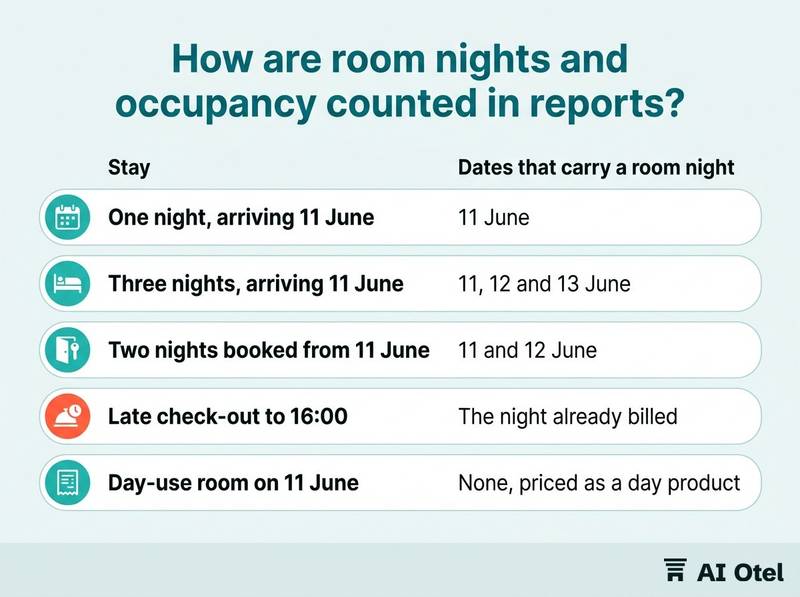
A three-night stay arriving on 11 June produces one room night on 11, one on 12 and one on 13 June, and none on 14 June. A 02:00 arrival on 12 June produces a room night on 11 June, which is how the report and the bill end up agreeing instead of contradicting each other.
Occupancy needs a matching denominator: the same date range and the same room count. Comparing a stay's nights against a month of availability is a common arithmetic error in a front-office report. The hotel's own occupancy and any published occupancy figure may rest on different definitions, so always label which one is being quoted.
Consistency is the check: if the bill says three nights and the report says two, the arrival date was entered wrong, not the rate. In group blocks, rooms picked up from a block are counted on the night they are used, not on the date the block was signed.
| Stay | Nights billed | Dates that carry a room night |
|---|---|---|
| One night, arriving 11 June, leaving 12 June | 1 | 11 June |
| Three nights, arriving 11 June, leaving 14 June | 3 | 11, 12 and 13 June |
| Two nights booked from 11 June, guest arrives 02:00 on 12 June, leaves 13 June | 2 | 11 and 12 June |
| Late check-out to 16:00 on the departure day | 0 extra nights unless the policy charges a night | The night already billed |
| Day-use room on 11 June with no overnight | 0 room nights | None, priced as a day product |
What do you say to a guest who counts differently?
Say the rule in one sentence, then show the dates. Guests rarely argue with a dated bill; they argue with a number that arrived without one.
A working script: you booked the night of 11 June, your flight lands at 02:00, so that is the night you are in; you leave on the morning of the 13th, and that day carries no room charge. Put the same sentence in the confirmation, the pre-arrival message and a guest app, so the desk is not the first place the guest hears the rule. A hotel that runs its counts, its messages and its reports from one hotel operating system keeps those words identical everywhere.
When a guest asks for a late check-out, answer with the time boundary and the price together, not with a promise to see what can be done. When a guest disputes the count, open the dated bill and read the nights aloud; the conversation moves from opinion to dates in one step. Log the disagreement on the reservation so the next shift does not reopen a question that was already settled.
ChecklistThe rule card for the desk
- The arrival date, not the clock time, names the first night.
- The departure date carries no room charge.
- A late check-out is a time and a price, quoted from the written policy.
- A rate change moves only the nights it covers.
- Every dispute ends at the dated bill.
Write the rule down once
Write your counting rule down once, in the lines on the desk card, and use the same words on the confirmation, the bill and the report. The ideas in this article are one idea seen from four places: the night belongs to the date it starts, so the arrival date fixes the first night, the departure day carries none, a rate change moves only the nights it covers, and the report counts exactly what the bill charged.
If you are a traveler reading this rather than hotel staff, the same rule helps you book the right night: when your flight lands at 02:00, book the date of the night you will sleep in, and you can find a hotel in Türkiye (opens in a new tab) with that date in mind.
Frequently asked questions
Does 3 nights mean 4 days at a hotel?
Yes, in the calendar sense. The arrival day, the three nights and the departure day touch four dates, but only three of them are charged as nights. The departure day can carry service charges such as breakfast or a late check-out, and it carries no room charge.
What time is hotel check-out in Türkiye?
No single time applies across hotels. Each hotel sets its own check-in and check-out times and should show them in its policy and on the confirmation. Ask at booking, and ask on the same call what a late check-out would cost and until what time it runs.
Can a hotel charge for a night the guest did not sleep in?
If the room was held for that date, the night was sold, and a very late arrival or a no-show still consumes it. What the hotel then does about the charge is set by its cancellation and no-show policy, which belongs in the booking terms the guest accepted.
How is a stay billed when the rate changes in the middle?
Night by night. Each night takes the rate attached to its own date, and the total is the sum of those nights. Ask for a dated bill so the split is visible, and check that the nights on the bill match the dates of the stay.
How do hotels count nights when the guest arrives after midnight?
The same way as any other arrival: the night belongs to the date the room was held from. A guest who arrives at 02:00 on 12 June has used the night of 11 June, and the bill and the report both date it to 11 June.