Parcels and couriers for hotel guests: receiving, logging, storing and handing over
This guide outlines a four-step routine for handling hotel guest packages. It covers signing, logging, storing and handing over parcels to prevent disputes.
AI draft · awaiting editorial review
Contents
Key takeaways
- The front desk, not the courier, decides whether a parcel is accepted: check the label against a reservation before signing, and refuse what the hotel cannot identify or store safely.
- A parcel log earns its keep through five fields: time received, courier and tracking number, the name exactly as printed on the label, the storage place, and the handover signature.
- Cold, fragile and valuable items need their own storage rules, and the hotel should say in writing that it does not guarantee a cold chain.
- Tell the guest in a short message that names the collection point and its hours, never the medical contents or the sender.
- Parcels for departed or unknown guests follow the hotel's own written holding and disposal policy, not an assumed legal period.
A hotel parcel routine has four steps: a named staff member signs and checks the label against a reservation, the parcel goes into a log with time, courier and tracking number, it is stored in a labeled, access-limited place, and it is handed over against a name, room and signature. The hotel writes its own holding and disposal rules.
A courier puts a box on the desk at 23:40, the label carries a name nobody recognizes, and the night receptionist has to decide in ten seconds whether to sign. What happens next is either a routine or an argument three days later. This article turns hotel guest packages at the front desk into one routine: what to check before signing, what the log must contain, where and how long parcels are stored, how the guest is told, and what happens to the parcels nobody collects. Every section gives you something you can put on paper and use on the next shift.
What kinds of parcels arrive at a hotel for a guest?
Four families arrive, and each one sets a different clock: gifts and flowers, medicine and pharmacy orders, documents, and online orders or business freight. The type decides how fast the guest must be told and where the parcel is stored.
Flowers and food are perishable and set the shortest collection window. They are also a case where a phone call beats a written message, because a guest who misses a text about flowers finds a vase of dead stems two days later. Medicine arrives from a pharmacy or a courier in a chilled box: accept it, store it as the label says, never open it, and record it in the log as a pharmacy package without describing the contents.
Documents and envelopes are light, high value and easy to lose, so they belong in locked storage with an identity check at handover. Online orders often arrive cash on delivery; the hotel is not the buyer, so the guest pays the courier or the parcel is not accepted. Group freight, wedding materials and conference equipment are addressed to the hotel, not to a guest, and should be routed to the events or sales contact instead of the guest shelf. Anything addressed to a staff member, a former employee or a company with no reservation is not a guest parcel and belongs with the duty manager.
| What arrives | What it changes | Where it is stored |
|---|---|---|
| Flowers and food | Shortest window, call the guest | Cool spot away from heat |
| Chilled medicine | Do not open, generic log entry | Refrigerator with a temperature record |
| Documents and envelopes | ID check at handover | Locked place |
| Online order, cash on delivery | Guest pays, hotel does not advance money | Dated shelf |
| Group or event freight | Route to events or sales | Not the guest shelf |
| Oversized item | Accept only if a defined storage place exists | Defined storage place only |
Who signs for a delivery, and what should be checked at the door?
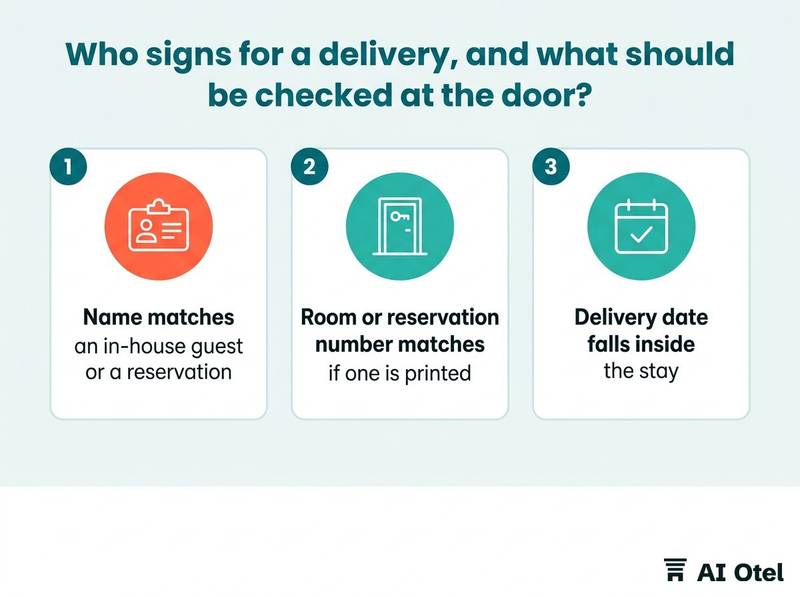
One named person per shift signs, after three label checks: the name matches an in-house guest or a reservation arriving inside the hotel's holding window, the room or reservation number matches if one is printed, and the delivery date falls inside the stay. Name the receiver in the shift handover, so that every signature has a person behind it rather than whoever happened to be near the door.
Refuse or hold at the door when no name matches any reservation, when the packaging is leaking or visibly crushed, when a cash-on-delivery charge arrives with no guest instruction, or when the hotel has nowhere safe to keep the item. Never sign as unchecked: if the packaging is damaged, write the condition on the courier's device or paper and photograph the parcel before it leaves the courier's hands. Take the courier's tracking number and the time even when the courier's device already holds them; that number is what answers every later question.
Accept pre-arrival parcels only when the reservation exists and the arrival falls inside the written window; otherwise ask the sender to time the delivery to the stay. When a guest extends or shortens a stay, and the room is already involved in another booking, the parcel window moves with them, so the desk should recheck open parcels against the new departure date. The same applies when a guest extends the stay and the room is already sold: the room plan and the parcel log both need a second look.
ChecklistAt the door, work through this sequence
- Ask the courier for the recipient name and read it yourself.
- Search the in-house list and the arrivals list for that name.
- Compare the room or reservation number if one is printed.
- Look at the packaging on all sides.
- Photograph any damage before signing.
- Write the tracking number and time on the log sheet.
- Sign with your own name or initials, never a shared code.
- Place the parcel in its storage zone before returning to the desk.
What should a front desk parcel log contain?
The log records the parcel at the moment it is received and closes only at handover, and it carries enough fields that a person who was not on shift can answer the guest, the courier and the manager from the page alone. Write the entry when the parcel arrives, not at the end of the shift; memory is the weakest link at 03:00.
The core fields are: date and time received, courier company, tracking number, recipient name exactly as printed, reservation number or room, sender if shown, number of pieces, condition on receipt, received by, storage place, guest notified with channel and time, and handover with date, time, ID check, signature and staff initials. The tracking number is the field that earns the most: it lets the hotel answer the courier's query and the guest's question days later.
Paper or system matters less than the rule. If paper, use one numbered book kept with the shift handover, never loose sheets. Check the log at every handover, the same way you would work through a front desk shift handover checklist: read the open entries aloud, count the shelf, and confirm that the log and the shelf hold the same parcels. Close an entry at handover only, never when the guest is merely told the parcel has arrived.
| Field | Why it matters |
|---|---|
| Date and time received | Shows how long the hotel has held it |
| Courier and tracking number | The main way to trace or return a parcel |
| Name as printed | The label, not the reservation spelling, is what the courier asks about |
| Room or reservation | Links the parcel to a stay |
| Condition on receipt | Protects the hotel in a damage dispute |
| Received by | A person behind the signature |
| Storage place | Finds the parcel without searching |
| Guest notified, channel and time | Shows the hotel did its part |
| Handover with ID and signature | Closes the hotel's responsibility at the desk |
How should parcels be stored before collection?
Three zones cover almost everything: a dated shelf for ordinary parcels, a locked place for documents and valuables, and a refrigerator with a temperature record for medicine and food. Everything else is a storage problem the hotel should refuse at the door.
The parcel shelf is not the luggage room. Luggage is tagged to a stay and leaves at check-out, while parcels have their own date order and their own log; the two routines are described separately in a hotel luggage storage procedure with tags and a log. Label each parcel with the log number, not only the guest name; two guests with the same surname in one week is ordinary, not exceptional.
Store fragile items low with nothing stacked on top, and keep the courier's packaging intact so the guest can see how it arrived. Limit access to one cupboard or one key held by staff who appear on the log; corridors, lobby corners and unstaffed back areas are where parcels disappear. For chilled items, record the refrigerator temperature and tell the guest in writing that the hotel does not guarantee a cold chain. Never open a parcel to find out whose it is; the label, the log and the courier are the only identification tools the desk should use.
Watch outThree things that turn a stored parcel into a complaint
Do not open a parcel to identify the owner. Do not promise a cold chain for medicine. Do not leave a parcel in a corridor, a lobby or an unlocked back office, even for ten minutes during a busy check-in.
How do you tell the guest that a parcel has arrived?
Send a short message in the same shift, naming what arrived in general terms, where to collect it and the desk's hours, and record that you sent it. Keep the description generic: a package, flowers, an envelope. Never name medical contents or a sender in a message that another person in the room might read.
Use the channel the guest already uses for the stay; for perishables, medicine and same-day departures, a phone call is the right channel and the message is the backup. Say what to bring: the guest's name and room number, and an identity document for documents or valuables. Write the template once in each language the desk works in, short enough that it survives translation without losing the collection point or the hours.
Log the notification with channel and time; if the guest does not respond and departure is close, raise it at the shift handover rather than at check-out. If the guest asks a third party to collect, take the instruction in writing and record who gave it.
TipSample wording to translate
"Good evening, this is the front desk. A package addressed to you arrived today at 18:20. You can collect it at reception, open 24 hours. Please bring your room number; for this item we will also ask for your identity card. If you would like us to hold it until a later date, reply to this message." Keep the parcel type generic, and never name the sender or the contents.
What does a correct handover look like, and what if the parcel is damaged?
The handover is a match, a check and a signature: match the person to the log entry, check identity where the item warrants it, and close the entry with a signature at the moment the parcel leaves the shelf. Ask for the name and room, find the log entry, and compare it with the label before the parcel is touched.
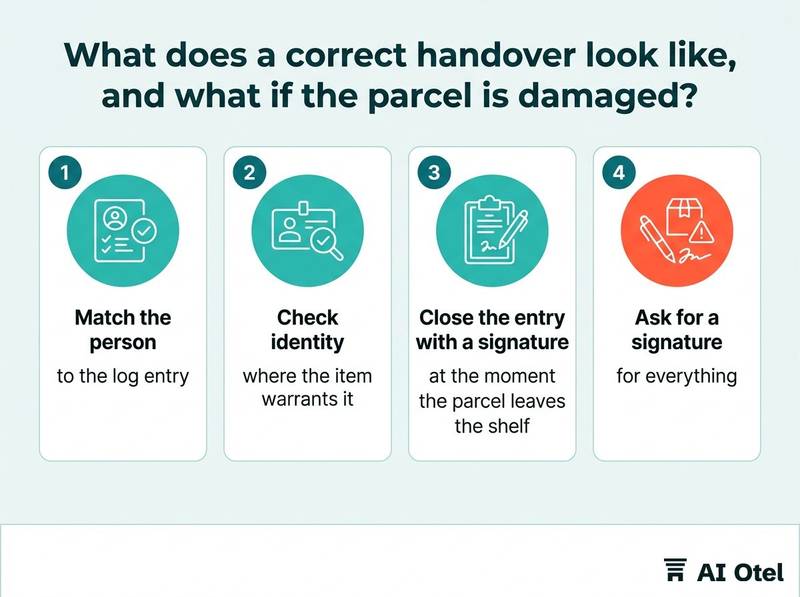
Ask for an identity document for documents, valuables and anything the hotel flagged at receipt; ask for a signature for everything. If the packaging was already damaged on arrival, show the guest the photograph, note the condition on the log and have the guest sign the note before taking the parcel. If the guest says the parcel is not theirs, do not hand it over; recheck the label and go back to the courier or the sender. If the guest refuses the parcel, record the refusal, the time and the reason, and follow the hotel's return rule.
Customs charges, duty and cash-on-delivery amounts belong to the guest or the sender; the hotel neither pays nor advances them. Close the log entry at the moment of handover, with time, identity check and staff initials.
ChecklistHandover check
- Name and room given by the guest.
- Log entry found and label compared.
- Identity document seen where required.
- Condition shown and noted if damaged.
- Charges settled between guest and courier, not the hotel.
- Signature taken.
- Entry closed with time and initials.
- Parcel removed from the shelf count.
What happens to parcels for guests who have left or never arrive?
They follow the hotel's own written policy: a holding window set per parcel type, two logged contact attempts, forwarding only on the guest's written instruction, and a recorded disposal at the end. The hotel writes that window itself; it is a management decision, not something to assume.
Put the holding window on one page, per parcel type, and keep it where the desk can see it: a shorter window for perishables and medicine, a longer one for documents. Before the window closes, make two contact attempts and log both, one to the guest's number and one to the booking channel or the sender if the label shows one. Forward only on the guest's written instruction, at their cost, with a tracked courier, and write the new tracking number into the log.
Where the label allows it, return to sender and record the return tracking number; this is often cleaner than holding an item the hotel cannot value. Disposal follows the written policy, with a witness and a record; do not open the parcel, do not sell it, do not pass it to staff. Keep the closed log entry after disposal; the record is the hotel's protection when a guest asks months later. The routine sits next to your hotel lost and found logging and return procedure, and the two policies should use the same contact-attempt and disposal wording.
NoteThe policy is yours to write
The holding window, the contact attempts and the disposal method are the hotel's own written decisions. Check them with a legal adviser before publishing them to guests, and keep the same wording in every language the desk uses.
What to do next
Write the one-page policy and the log sheet this week, then run one shift with them before rolling them out. The shelf, the log and the message template only work when the same person signs, records and hands over, and the policy answers the question the night receptionist faces at 23:40.
Frequently asked questions
Can the front desk accept a parcel for someone who is not yet a guest?
Only when a reservation exists and the arrival falls inside the hotel's written holding window. Otherwise the parcel has no owner the hotel can verify and no shelf date it can plan around, so ask the sender to time the delivery to the stay.
Should the hotel pay a cash-on-delivery charge for a guest's parcel?
No. The hotel is not the buyer, and advancing money turns a delivery into a debt the desk has to collect. Either the guest pays the courier, or the parcel is not accepted and goes back with the courier, recorded in the log.
How long should a hotel keep a parcel for a guest who has checked out?
The hotel sets that window itself, per parcel type, in a written policy, with a shorter window for perishables and medicine. This article does not state a legal period; confirm the wording with a legal adviser before publishing it to guests.
Can staff open a parcel to find out who it belongs to?
No. Use the label, the log and the courier instead. Opening a guest's parcel creates a privacy problem and a dispute about contents that the hotel cannot win, and it is never needed to identify an owner.
What should the desk do when a parcel arrives damaged?
Photograph it before signing, write the condition on the courier's record and in the log, and show the guest the photograph at handover. The guest then signs the condition note before taking the parcel, which keeps the question of who damaged it out of the hotel's hands.