Meeting room revenue per square meter and per hour: a sheet for owners
Learn to measure meeting room performance by revenue per square meter per available hour. This guide provides a sheet to rank rooms and clear rules for repricing, splitting, converting, or closing underperforming spaces.
AI draft · awaiting editorial review
Contents
Key takeaways
- A meeting room's floor area is a cost before it is an asset: heating, cleaning, furniture and standby staff are paid whether the room sells or not.
- Count only the hours a room can realistically be sold, and subtract setup, reset and turnaround time before you divide anything.
- Put space rental, attached food and beverage and event room nights on one line, with a written attribution rule that does not drift between months.
- Judge a room on revenue per square meter per available hour over a rolling twelve months, never on one good month or one large booking.
- Every room ends in one of four decisions: reprice, split, convert or close; a room with no decision is a decision to keep paying for it.
Meeting room revenue per square meter is the measure that makes rooms comparable: all the money a room brings, meaning space rental, attached food and beverage, and the room nights it generates, divided by floor area times the hours it could realistically have been sold. Size and headline rate tell you capacity, not income.
An owner walks into the ballroom, sees the size and asks what it rents for. The better question is what each square meter of it earned last month, hour by hour, and what that same square meter would earn as something else. This article gives you the denominator, the revenue lines, the sheet and the decision rules, so you can build the ranking yourself from your own records and act on it this quarter.
Why is a large meeting room not automatically a profitable one?
Because floor area is capacity, not income. A large room is paid for every month and earns only in the hours it is sold, so a small room sold often can beat a big room sold rarely on the same square meter.
The fixed cost of a room is set by its area. Heating and cooling, lighting, cleaning, furniture upkeep and the staff who must be on standby for any event, sold or not, all scale with square meters. Capacity turns into money only when demand fills it, and a ballroom that hosts a handful of events a year can earn less per square meter than a boardroom booked several times a week.
A day rate also hides the hours. A room quoted for a full day but used for three hours is a very different price per hour, and the owner never sees the difference on the invoice. Setup style changes usable capacity too: the same room holds far fewer people in classroom or U-shape layout than in theater layout, and the price rarely follows the layout. If you have not worked this out per room, see how setup styles change a room's real capacity.
A large room also blocks the calendar. It takes the same coffee-break labor and the same parking as a small one, but it cannot be sold twice in a day if the reset takes hours. The check is simple: put every room on one denominator, revenue per square meter per available hour, before comparing any two of them.
How do you count the hours a meeting room could have been sold?
Available hours are the days in the month multiplied by the hours the room can realistically be sold, minus blocked time for maintenance, deep cleaning, seasonal closure and house use. Used hours are the contracted hours, including setup and breakdown, because the room is unavailable then too.
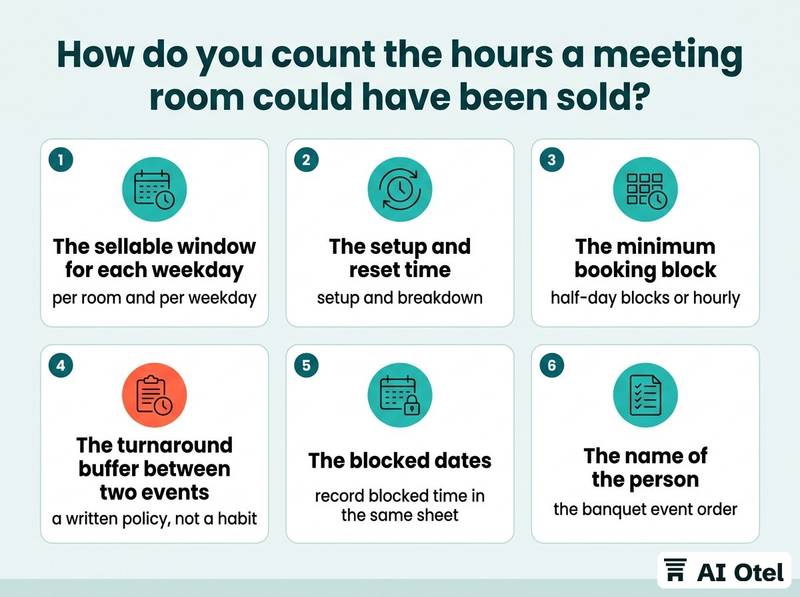
Write the sellable window per room and per weekday. A boardroom may only be sellable from morning to early evening on weekdays; a ballroom may be sellable any day but needs a long reset after a gala. Match the sheet to how the sales team quotes: if you sell half-day blocks, count hours in half-days; if you sell hourly, count hours. A sheet that disagrees with the quotation will be ignored.
Set a turnaround buffer between events as a written policy, not a habit. The length is your choice; what matters is that the same buffer is subtracted every month. Take the actual hours from the event document that runs the day, not from memory or from the sales pipeline; the banquet event order is the record of hours actually used.
Be honest about the denominator. Counting twenty-four hours a day makes every room look idle; counting only booked hours makes every room look full. Neither number supports a decision. Record blocked time in the same sheet: a room closed for renovation for six weeks should show it, or its utilization will look like a management failure when it was a building site.
ChecklistBefore counting a single hour, write down for each room
- The sellable window for each weekday.
- The setup and reset time per layout.
- The minimum booking block the sales team quotes.
- The turnaround buffer between two events.
- The blocked dates for maintenance, closure and house use.
- The name of the person who records actual hours, and from which document.
Which revenue belongs in the meeting room sheet?
Three streams belong on the line: the space rental, the food and beverage attached to the event, and the room nights the event brings. Everything else is either a separate column or left out everywhere, never mixed in one month and out the next.
Attribute food and beverage to the event, not to the restaurant. If the coffee breaks land in the restaurant's report, the meeting room looks poor and the restaurant looks excellent, and both numbers are wrong. Count room nights only where the event brought them and they would not have been sold otherwise: a congress that fills rooms in a soft week is worth more than the same rooms taken in a week that would have sold out anyway. For how groups actually release and fill blocks, see room blocks, release schedules and what a congress group really brings.
Decide whether room nights enter at the room rate or at net room revenue, write the choice down, and keep it for the whole year. Treat audio-visual, parking, transfers and spa as either a separate column or an exclusion; consistency matters more than which choice you make.
Accept that the sheet is a management view, not a second ledger. If the restaurant report already holds the coffee-break revenue, the meeting room sheet re-attributes it for decisions; it does not create new income. Date the attribution rule. When the rule changes mid-year, the trend line breaks and every comparison across months becomes an argument.
How do you build the sheet: rooms, months and a ranking?
One row per room per month, a rolling twelve months, and a ranking by revenue per square meter per available hour. The ranking is the point; the totals explain it.
Build the rows from the room list, not from the events calendar. Every sellable space appears every month, including the months it earned nothing. Keep the column definitions identical every month: a sheet that changes shape cannot show a trend, and a trend is what an owner acts on.
Rank by revenue per square meter per available hour first, then read total contribution beside it. A small room can win the ranking and still be a minor part of the hotel's event income. Add a note column for one-off events, closures and rule changes, so that a strange month explains itself a year later. Review it monthly with the sales team and the food and beverage team in the same room: the sales team knows why hours were lost, the kitchen knows why the spend per event moved.
The table below shows the shape of the sheet. The figures are illustrative only; your own records replace them.
| Room | Area, sellable and sold hours | Total revenue (rental, F&B, room nights) | Revenue per m² per available hour |
|---|---|---|---|
| Ballroom (illustrative) | 420 m² · 320 h · 74 h | 186,000 | 1.38 |
| Salon A (illustrative) | 150 m² · 300 h · 168 h | 121,000 | 2.69 |
| Boardroom (illustrative) | 38 m² · 240 h · 152 h | 39,000 | 4.28 |
| Meeting room 4 (illustrative) | 26 m² · 240 h · 31 h | 6,800 | 1.09 |
| All rooms (illustrative) | 634 m² · 1,100 h · 425 h | 352,800 | 3.21 |
In this example the boardroom earns the most per square meter per available hour while contributing the least in total, and the ballroom carries volume with a weak rate. That contrast is exactly what the sheet exists to show. Label every figure you put in front of a board as illustrative until it comes from your own records.
What do you do with the result: reprice, split, convert or close?
Each room ends in one of four decisions, and each decision has a test. Reprice when the hours sell but the money per hour is low; split when demand is for small rooms and the space is one large one; convert when the space loses on every measure; close when it earns too little to justify its running cost.
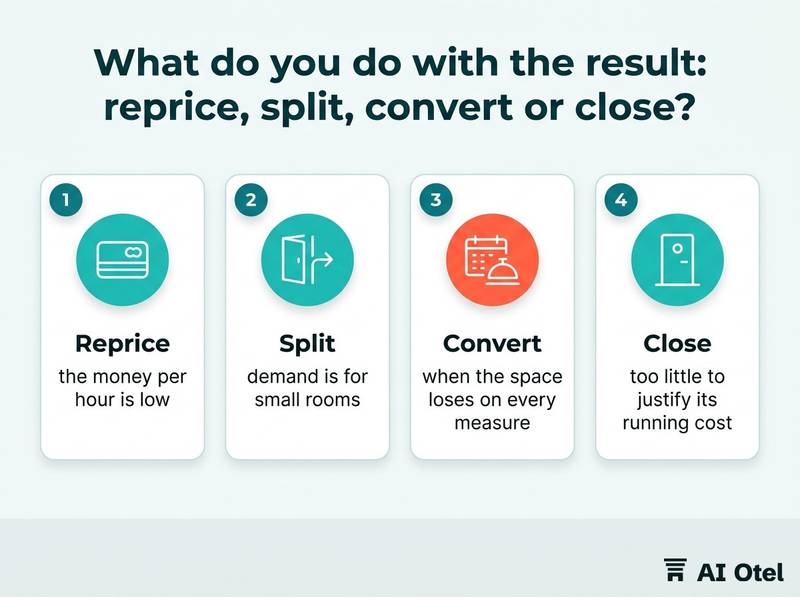
Reprice by setting an hourly minimum, a minimum spend per delegate, or a minimum food and beverage attached to the rental, and print the hours covered on the quotation so the buyer sees what a day rate actually buys. Splitting pays only if both halves can be sold independently, with their own access, their own climate control and their own audio-visual; the wall is the cheap part, the second entrance is not.
Convert by comparing the alternative on the same denominator, revenue per square meter per available hour, and adding the conversion cost and the cost of reversing it later. A gym, offices, storage or day-use rooms all have different opening hours, and the hours change the comparison. Closing means taking the room out of the sellable hours, stopping heating, cooling and cleaning, and keeping it as backup for peak dates. A closed room with an honest zero is better than an open room with a flattering denominator. If closing is not the answer, renting out unused space off-season may be.
Key pointThe four-line decision rule
If hours sold are high and revenue per available hour is low, reprice. If demand is for smaller rooms than you have, test a split. If the room sits at the bottom of the ranking for a full twelve months with no one-off explanation, cost a conversion. If the room cannot cover its running cost in any month of the year, close it and record the zero.
Change one thing at a time and give it a full season. A price change made in the same month as a partition installed teaches you nothing about either. Bring the decision to the same monthly review as the sheet, so that the ranking produces an action rather than a report.
When do the numbers mislead: seasonality and one-off events?
When a single event or a short season dominates the year. One gala can carry a room's annual total, and a room that only earns in high season has a denominator that flatters it for the other eight months.
Read the median month, not the average. One extraordinary booking pulls an average upwards and hides eleven ordinary months underneath it. Separate recurring corporate business from one-off events in the sheet, so that a room's regular earning power is visible next to its luck. For a seasonal room, consider counting available hours only in the months it can realistically be sold, and say so in the note column: a room closed in winter should not be judged as if it were open.
Watch for attribution drift. A new salesperson recording coffee breaks differently will move the ranking without any change in the building. Note renovation, closure and rule-change months explicitly; a utilization figure without that note invites the wrong conclusion. Treat any comparison between two hotels, or between your hotel and a published figure, with suspicion unless the definitions match exactly.
Watch outOne month is not a ranking
A room ranked last on a twelve-month sheet may simply have hosted the hotel's biggest event in the first month and nothing since. Check the note column before acting on the ranking, and never reprice or convert a room on the strength of a single month.
What to do next
Pick one meeting room, build the sheet for the last twelve months from your own records, and take one decision on it this quarter: reprice, split, convert or close. The measure is revenue per square meter per available hour, the ranking tells you where to look, and the note column stops the ranking from lying. If you want to see how measurement like this fits into a wider hotel system, read about a hotel operating system, built and working, ahead of launch, and the platform it belongs to, or look at how hotels and tourism businesses connect in Türkiye.
Frequently asked questions
Should a meeting room be priced per hour or per day?
It depends on what your market actually buys: small boardrooms suit hourly and half-day blocks, large rooms suit day rates with a minimum spend attached. Publish both, print the hours each covers on the quotation, and let the sheet show which unit your buyers choose. The unit is a sales decision; the measure stays revenue per square meter per available hour either way.
How do I compare a meeting room with a gym or with offices?
Put both on the same denominator, revenue per square meter per available hour, using each use's realistic opening hours. Add the conversion cost, the running cost and the cost of reversing the change. A gym earns on memberships across long opening hours; offices earn a fixed lease across working hours; the hours are what make the comparison fair.
Do room nights belong in meeting room revenue?
Yes, when the event brought them and they would not have been sold otherwise. Write the attribution rule down, decide whether rooms enter at the room rate or at net room revenue, and apply the same rule every month. Without a written rule the room nights drift between the rooms report and the events report, and both numbers become unreliable.
What utilization rate should a meeting room reach?
Set your own baseline from three to six months of your own sheet rather than borrowing a figure from outside, because sellable hours differ by room, by city and by season. Then judge every change against that baseline. Utilization alone misleads: a room can be busy with low-value bookings and still lose to an emptier room with better ones.
How do I handle a room used once a year for a gala?
Keep the gala in the sheet but flag it in the note column, and judge the room's recurring business on the median month rather than the annual total. If the gala is the only reason the room exists, that is a legitimate answer, as long as it is written down and the running cost for the other eleven months is counted against it.