The key card that stopped working: a five-minute check for the desk
A dead key card usually fails at one of four layers: the card, the data, the encoder or the lock. This guide gives the desk a fixed order of checks to resolve the issue quickly and log the replacement.
AI draft · awaiting editorial review
Contents
Key takeaways
- A dead card is a fault at one of four layers: the card, the data on it, the encoder or the lock, and the desk checks them in that order.
- Read the card on the encoder before rewriting it: the room, the guest name and the validity window show whether the fault is in the data.
- A fresh card that also fails at the same door means the lock, not the guest, and the room should come out of sale until it is fixed.
- No new card without an identity check: the person asking must match the reservation or be cleared by the lead guest.
- One line per replacement in a shared log turns repeated complaints into a visible lock or encoder problem.
A hotel key card not working usually fails for one of four reasons: the card is damaged, the dates or room written on it are wrong, the encoder wrote it badly, or the lock itself is at fault. The desk checks them in that order, re-encodes, tests at the door and logs the replacement.
It is a quarter to midnight. A guest in a dressing gown is at the desk with a card that will not open the door, and there are four people behind them. The five minutes that follow decide whether the night runs quietly or the same complaint comes back at two in the morning. The desk follows a fixed order of checks: read the card, confirm the room, the dates and the person, re-encode, test at the door, and write one line in the log.
Why does a hotel key card stop working?
Almost always at one of four layers: the card itself, the data written on it, the encoder that wrote it, or the lock that reads it. Sorting the complaint by layer tells the desk what to do next.
The card layer covers physical damage: a crack along the edge, a bent corner, a scratch across the chip or the antenna inside, a punched hole for a key ring, or storage next to a magnet in a wallet with a magnetic clasp.
The data layer covers what was written: an expiry set to the wrong date or time, a card written for the previous room after a move, a card reused from an earlier stay, or a validity window that ends at midnight instead of at departure.
The encoder layer covers the machine: a dirty read head, the wrong property or lock series selected on screen, a batch of blanks that was never prepared, or an encoder that has dropped off the network.
The lock layer covers the door: a fading battery, a dirty or misaligned reader, a door that has swelled in humidity, or a lock clock that has drifted away from the desk clock.
Order matters because the cheapest checks come first. Reading a card takes seconds; sending a technician to a door takes a trip. Note also that the word guests use is often wrong. A contactless card does not demagnetize; if the property uses magnetic-stripe cards, a magnet can wipe the stripe, but a contactless card fails for other reasons, and the desk should read it rather than guess.
| Layer | What the desk sees | Who checks it | Rough time |
|---|---|---|---|
| Card | Visible damage, no read at the encoder | Front desk | Under a minute |
| Data | Card reads, but room, name or dates are wrong | Front desk | Two minutes |
| Encoder | Card will not write, or writes to the wrong series | Front desk, then technical service | Five minutes |
| Lock | A fresh card fails at the same door | Technical service | Same shift |
What should the desk read off the card first?
Put the card on the encoder and read it before writing anything. A read tells you the room, the guest name and the validity window the card is carrying, which separates a card fault from a data fault.
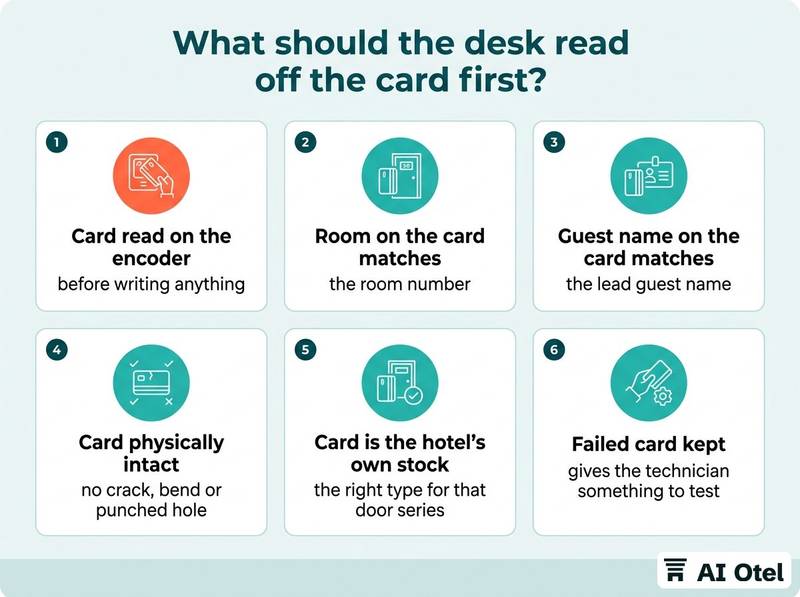
Read first, write second: a rewrite destroys the evidence of what the guest was actually given. Compare the read against the reservation on screen, checking the room number, the lead guest name, and the arrival and departure dates. Then look at the card in ordinary light for a hairline crack, a bent corner, a scratch over the chip or antenna, or a hole punched through the coil.
Check that the card is the hotel's own stock and the right type for that door series. A card from another property or an older series will read at the desk and fail at the door. Note what the encoder says when it refuses to read, because that message is the first line of the technical service call. Keep the failed card: it stops the same card being handed back to the guest and gives the technician something to test.
ChecklistBefore you write a new card
- Card read on the encoder
- Room on the card matches the reservation
- Guest name on the card matches the reservation
- Expiry matches the departure date and time
- Card physically intact, no crack, bend or punched hole
- Card is the hotel's own stock and the correct series
- Failed card kept, not returned to the guest
How do you confirm the room, the dates and who is asking?
The person at the desk must match the reservation before a new card is cut. Ask for the room number and the name rather than reading them out, then check both against the booking.
Ask, do not offer. Naming the room or the guest first confirms to a stranger that they guessed correctly. Check the lead guest name, the departure date, and whether the room was changed during the stay; a move is one of the most common reasons an old card stops working. For a second card, check who else is registered on the room before cutting one.
If the person is not the lead guest, call the room or the registered contact of the lead guest before issuing anything. Match the card's validity to the booking, not to the calendar day: a guest who extended needs a card that runs to the new departure, and a guest who arrived a day early needs the booking corrected first, as described in the note on a guest who arrives a day early or a day late. The fuller identity check, including what to do when the guest has left their identification in the room, is set out in the routine for checking who is asking before a new card or a locked safe.
Watch outNever confirm a room number, a guest name or a departure date to someone who has not identified themselves, and never cut a card for a room the person cannot show they belong to. If the check cannot be completed at the desk, call the room.
Never confirm a room number, a guest name or a departure date to someone who has not identified themselves, and never cut a card for a room the person cannot show they belong to. If the check cannot be completed at the desk, call the room.
How do you re-encode and test a card at the desk?
Write a fresh card, then walk it to the door and try it yourself before the guest does. A card that has not been tested at its own door has not been issued.
Use a new blank rather than rewriting the failed card; a card that failed once will usually fail again. Set the validity from the current time to the departure time, not from midnight to midnight. Test at the door with the guest present: open, close, reopen. One successful read can be luck; the second confirms it.
If the fresh card works, the fault was the card or the write. Log it and move on. If the fresh card fails at the same door, stop cutting cards: the fault is the lock or the encoder, and more cards will not fix it. Issue a second card where the reservation allows it, so a repeat failure does not send the guest back down a second time.
TipKeep a small stock of prepared blanks and a known-good test card at the desk. If the test card also fails at the door, the problem is the door, and the desk can say so to technical service with confidence.
Keep a small stock of prepared blanks and a known-good test card at the desk. If the test card also fails at the door, the problem is the door, and the desk can say so to technical service with confidence.
When is the fault in the lock, not the card?
When a card written fresh at the desk fails at the same door, and when more than one guest reports the same door, the lock is the fault. The room should come out of sale until it opens reliably.
Read the door, not just the card: no light on the reader, no sound from the mechanism, a stiff handle, or a door that needs a push before it lines up. A fading battery often shows itself as intermittent failure before it stops altogether, so a lock that worked this morning and not tonight is a battery signal. Log low-battery warnings and replace on a planned round rather than on a failure at night, as the low-battery log and the replacement round sets out.
Dirt, condensation and salt air foul the reader head; a loose handle or a dropped door frame moves the reader out of line with the card. Take the room out of sale, mark it, and tell housekeeping and the desk before the room is assigned again. Call technical service with the facts: room, time, card number, what the light did, and whether a fresh card failed. The note on how door locks, encoders and the hotel system connect explains what the technician will check.
NoteA lock that fails twice in one night is a room that cannot be sold safely. Move the guest, take the room out of sale, and let the technician work on it in daylight rather than at the door with the guest waiting.
A lock that fails twice in one night is a room that cannot be sold safely. Move the guest, take the room out of sale, and let the technician work on it in daylight rather than at the door with the guest waiting.
What should a card replacement log record?
One line per replacement, written at the moment it happens, with the room, the guest, who asked, how identity was checked, the card issued and the result at the door. The log is both a fault pattern and a record of who was given access to which room.
The pattern is the point: three replacements at one door in a week is a lock problem, and the log is the only place that shows it. The log is also the access record: it shows which person was given a card for which room, and who issued it. Record a lost card as lost, and note that the card stays valid until its expiry unless it is cancelled at the lock or the lock is reprogrammed.
Keep the log with the shift handover so the next shift reads it before the guest comes back. Use the same fields on every shift; a log filled in differently by each team hides the pattern it was created to show. The log holds guest names, so its retention period belongs in the hotel's own written rule, agreed with its data protection adviser.
| Time | Room | Guest, who asked | Card | Old card | Result | Staff |
|---|---|---|---|---|---|---|
| 23:52 | 412 | Lead guest, name and departure confirmed at desk | 0042 | No | Opened on second try | FD |
The row above is illustrative, for example only.
What to do next
Write the five checks into the desk routine tonight: read the card, confirm the room, dates and person, re-encode, test at the door, log the line. Each step is short, and together they turn a midnight complaint into a two-minute transaction while giving the hotel a record that shows whether the fault is the card, the encoder or the door. If the hotel's software records card issues and door events in one place, the log writes itself; a hotel operating system that keeps front desk, housekeeping and technical notes in one system, built and working, ahead of launch, is one way to hold that record, and the wider platform explains how the pieces connect.
Frequently asked questions
Can a guest's phone demagnetize a hotel key card?
Only if the card carries a magnetic stripe, and even then the usual culprit is a magnet in a wallet clasp or a bag closure rather than the phone itself. A contactless card does not hold data magnetically, so it fails for other reasons: a crack, a bent corner, a damaged antenna, wrong dates or a lock fault. The desk should read the card rather than accept the explanation.
How long should a key card stay valid?
Until the guest's departure time, not until the end of the calendar day. A card that runs past departure leaves a working credential in circulation; a card that expires at midnight locks out a guest who is staying another night. When a stay is extended or shortened, the card is re-encoded to match the booking.
Should the hotel charge the guest for a lost key card?
That is the hotel's own policy, and it works only if it is written down, displayed and applied the same way on every shift. The desk should record the loss in the replacement log either way, because a lost card stays valid until its expiry unless it is cancelled at the lock or the lock is reprogrammed.
What if the person asking for a new card is not the guest who booked?
Check who is registered on the room, then call the room or the lead guest's registered contact before issuing anything. A colleague, a family member or a driver may be legitimate, but the desk needs the lead guest's word, not the requester's. If the check cannot be completed, the card waits.
Why do the same guests keep coming back with dead cards?
Repeated failures at one door point to the lock: a fading battery, a dirty reader or a door that has moved out of line. Repeated failures across many doors point to the encoder or to how cards are being written. The replacement log separates the two, which is why it is worth more than the individual fixes it records.